Creatine and caffeine can appear in the same routine, but the research does not support a universal claim that caffeine cancels creatine. Studies differ in whether caffeine was taken daily during creatine loading or once before testing after loading. Results are mixed, and a short coffee-versus-caffeine trial reported mild digestive discomfort in one combined group. Read the actual product labels, include coffee and pre-workout in total caffeine, and record your own timing and symptoms without treating a personal log as a controlled trial.
Can you take creatine with coffee or caffeine? Many people do. The evidence does not show that a cup of coffee automatically “cancels” creatine, but it also does not justify a promise that every combination works the same way. The answer depends on what the study actually did: a short creatine loading phase with caffeine every day is a different experiment from taking one caffeine dose before exercise after loading.
This distinction is easy to miss if you read only a headline. Creatine monohydrate is normally discussed as a repeated routine that changes muscle creatine stores over time. Caffeine is often studied as a single pre-exercise dose. A report about the second design does not directly settle the first. The NIH Office of Dietary Supplements describes benefits and limits for each ingredient separately, and warns against assuming that a multi-ingredient product has the same effects as each ingredient studied alone.
What “together” can mean
Imagine three people who all say they combine creatine and caffeine. One adds creatine to morning coffee each day. Another uses creatine daily but drinks coffee only before a weekend workout. A third takes a pre-workout powder containing both, perhaps alongside an energy drink. The ingredients overlap, yet the timing, total caffeine, product formula and exposure over days differ. Their experiences cannot be reduced to one yes-or-no rule.
A research paper might test strength, sprint power or repetitions, not muscle creatine concentration or stomach comfort. A non-significant difference in one outcome does not establish equivalence in all outcomes. It may reflect a small study, a short period, an outcome that did not respond, or a truly similar effect; the result alone does not distinguish these explanations. Conversely, one uncomfortable workout after coffee does not prove a biochemical interaction.
The strongest practical question is therefore: Which exposure and outcome does this claim describe? If a study used several days of high-dose loading, do not silently translate its result into a long-term maintenance routine. If it tested one pre-exercise caffeine dose, do not call it evidence for drinking caffeine at every creatine dose.
Separate the study designs before reading the result
| Research setup | What happened | What it can and cannot tell you |
|---|---|---|
| Caffeine every day during creatine loading | Both ingredients were used over a short loading period. | It tests a concurrent short protocol, not every maintenance routine. |
| Creatine loading, then one pre-exercise caffeine dose | Muscle creatine was built up first; caffeine was added for a performance test. | It tests an acute caffeine effect after loading, not daily co-ingestion. |
| Coffee versus caffeine anhydrous during loading | A particular coffee preparation was compared with a measured caffeine dose. | It informs those trial conditions, not all coffees or product formulas. |
| Your ordinary routine | Meals, training, sleep, coffee strength and products vary. | A log can reveal a pattern to discuss, but cannot establish causation like a controlled study. |
Two systematic reviews reached cautious, design-dependent conclusions. Elosegui and colleagues included ten studies: among the studies with creatine loading before acute caffeine, three reported no interference with caffeine's benefit while one differed. With chronic concurrent use, findings ranged from interference to no interaction to synergy. Marinho and colleagues also reviewed ten studies and reported that acute caffeine after loading added a benefit over creatine alone in three of five relevant studies, whereas daily caffeine during loading added a benefit in one of five. Those patterns are not a proof that caffeine universally blocks creatine; nor are they a guarantee of extra performance from combining them.
The reviews do not erase differences in participants, exercise tests, doses or study quality. Even where studies reported an effect, the next question is whether that specific outcome resembles what you do. Strength testing, repeated sprinting and endurance work are not interchangeable. If you are deciding whether to change a routine, the table above is more useful than a single pooled slogan.
What the coffee study actually tested
A frequently quoted randomized trial by Trexler and colleagues enrolled 54 physically active young men. For five days, groups received creatine loading alone, creatine with approximately 300 mg/day caffeine anhydrous, creatine with instant coffee supplying about 303 mg/day caffeine, or placebo. The creatine groups used a loading schedule of 5 g four times daily. Participants completed strength and repeated-sprint measures before and after the protocol.
The researchers did not find significant between-group interactions for their reported performance outcomes. Four participants reported mild gastrointestinal discomfort in the creatine-plus-caffeine group; the other groups reported no side effects in the abstract. That observation is worth knowing, but four reports in one small group cannot predict whether a given person's stomach will react, and it does not establish that caffeine caused every symptom. The five-day male-only design also cannot answer what happens across months of maintenance or in everyone who drinks coffee.
This trial should not become a personal dosing instruction. It used a specific loading protocol to answer a research question. Someone taking a different amount, a different coffee, a blend with additional ingredients, or caffeine only on some training days is outside that exact comparison. The useful takeaway is methodological: the study compared defined combinations and measured defined outcomes, so we should keep those boundaries when applying it.
Coffee, pre-workout and total caffeine
“Coffee” is not a standardized caffeine amount. Cup size, bean, preparation and extra servings change what you consume. A pre-workout may add caffeine from multiple sources or other active ingredients. The FDA's caffeine guidance explains that caffeine content varies and that body weight, medicines, health conditions and individual sensitivity affect what is too much. The FDA's often-cited 400 mg/day figure is a general observation for most adults, not an individual target or an instruction to increase intake.
Read the Supplement Facts panel, serving size, caffeine amount and directions on a packaged product. Add up sources across coffee, energy drinks, pills and pre-workout rather than counting only the scoop with creatine. If a blend hides the quantity in a proprietary mix, record that uncertainty instead of inventing an exact total. The NIH ODS performance fact sheet cautions that many multi-ingredient products have not been tested as the exact combination sold.
Tolerance matters independently of exercise performance. Caffeine can be associated with nausea, restlessness and disturbed sleep; creatine can cause gastrointestinal distress in some people. A stomach complaint after a combined drink does not tell you which ingredient, dose, meal context or product additive mattered. For a different caffeine pairing focused on concentration rather than workouts, our L-theanine and caffeine article addresses that distinct question.
A routine log that changes one variable at a time
A brief record can turn a vague impression into a useful conversation with a pharmacist, clinician or sports dietitian. It is not a substitute for a randomized trial. Keep the training plan and other routine details as stable as practical, then note changes rather than announcing a cause after one day.
| Record | Example of useful detail |
|---|---|
| Product and label | Creatine monohydrate brand, pre-workout formula, coffee size, stated caffeine per serving. |
| Timing and meal | Clock time for each product, meal or empty stomach, training start. |
| What you noticed | Exercise type and comparable performance measure; stomach symptoms, restlessness, sleep. |
| Other changes | New medicine or supplement, unusual training, illness, different coffee or multiple servings. |
For instance, if the only planned change is moving coffee from before to after training, record that change and the rest of the context for more than one session. Do not interpret a single better workout as proof of synergy. Sleep, training intensity and expectations can change performance too. If the issue is digestive discomfort, note where and when it occurs, whether it recurs, and the complete product list. Persistent or concerning symptoms deserve clinical assessment rather than repeated experiments with a product that feels wrong.
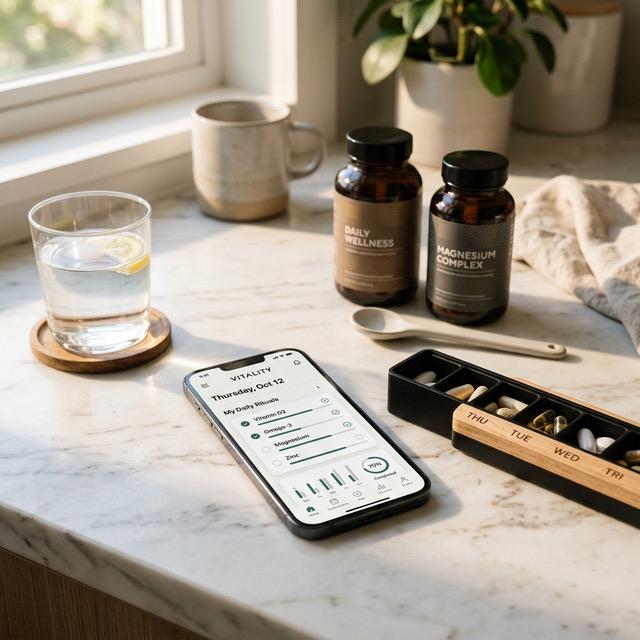
Supplement Tracker can hold the product names and schedule so the record does not depend on memory. Our guide to tracking supplements consistently covers keeping a stable routine. The decision to use either ingredient, and in what amount, still belongs to the person and their healthcare professional when individual health factors matter.
Read the evidence at the right scale
The current evidence supports a narrow, useful answer: caffeine is not proven to universally cancel creatine, and study outcomes depend on the protocol. Acute caffeine after creatine loading is different from daily caffeine during loading; neither is identical to every coffee-plus-creatine habit. The most honest next step is to identify your actual products and total caffeine, note tolerability and training context, and avoid changing several variables at once. That leaves you with information you can use without turning uncertain research into a rigid rule.