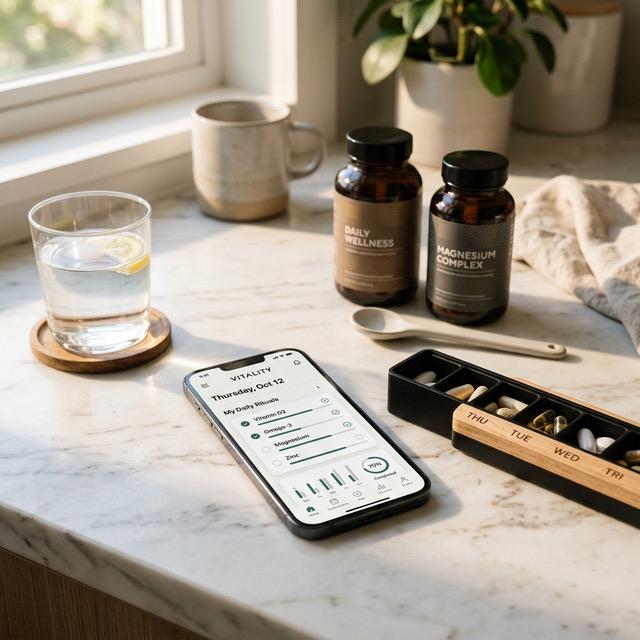
Tell your surgeon and anesthesia team about every supplement you use, including occasional products, powders, herbs, vitamins, and combination formulas. Bring labels, amounts, schedules, and last-dose dates. Different hospitals give different stop instructions, so the team responsible for your procedure should decide which products to pause, continue, or restart. Do not stop prescribed medicines based on a supplement checklist. If surgery is close and you have not received instructions, contact the team now instead of guessing.
Your surgery date is on the calendar. You have received instructions about food and prescription medicines, but the bottles in your cupboard have not come up: a multivitamin, magnesium, a sleep blend, perhaps a powder you use only after training. Do those count?
Yes, they belong in the preoperative conversation. The American Society of Anesthesiologists asks patients to disclose herbal and dietary supplements, including vitamins, and suggests bringing the bottles. Some products can affect bleeding, blood pressure, medicines, or anesthesia. Which ones matter to you depends on the product and the planned procedure.
The useful task is not to memorize an internet stop list. It is to give your surgical team a complete record and get a specific instruction for every product. This guide includes a worksheet you can copy into a note or print.
Why a supplement list matters for surgery
"Natural" describes a product's marketing category, not its effect in an operating room. The FDA says supplements can interact with medicines, interfere with laboratory tests, or have dangerous effects during surgery. The ASA identifies potential effects on bleeding, blood pressure, heart function, and anesthesia. It does not say every supplement causes every problem.
A product may contain several ingredients even when the front label names only one. A sleep product can combine a vitamin, a mineral, and an herb. A training powder may have multiple botanical extracts. A multivitamin repeats ingredients found in separate bottles. The team needs the actual Supplement Facts panel, not the broad product category.
The label itself can be easy to misread. Amounts may be listed per serving rather than per capsule, and serving size may be more than one unit. Our label-reading guide explains how to copy the amount accurately. You do not need to decide whether a listed ingredient affects anesthesia; your job is to make the information available.
Who should get the information?
Start with the surgical office or preoperative assessment team, and make sure the anesthesia team receives the same list. The ASA patient brochure specifically tells patients to discuss supplements with the physician anesthesiologist. MedlinePlus also says to tell the surgeon about medicines and supplements bought without a prescription and to bring a list with doses and frequency.
If a different clinician prescribed a supplement for a diagnosed condition, include that clinician and the reason. A prescription iron plan, for example, is not interchangeable with a self-chosen "wellness" bottle. Do not independently stop prescribed medicines, including blood thinners or diabetes medicines, because you saw them on a supplement page. Your surgery team and prescribing clinician need to coordinate those decisions.
Tell the team about products used occasionally as well as daily ones. "I haven't taken it this week" is useful only when paired with the date you last did take it. If you cannot remember, say that rather than inventing a date.
The label-and-last-dose worksheet
Copy one row per product. The example values below are fictional; they demonstrate documentation, not a safe or unsafe product list.
| Product | Label and serving | Your actual use | Last dose | Decision from your team |
|---|---|---|---|---|
| Example multivitamin | Photograph the front and Supplement Facts; record the serving size | One tablet with breakfast most days | Date or "unsure" | Continue, pause, or ask again: write the team's answer |
| Example sleep blend | Photograph every ingredient, including herbs | Only on some nights | Date or "unsure" | Record who gave the instruction and when |
| Example workout powder | Photograph the full label and lot if available | On training days | Date or "unsure" | Ask whether it matters before this procedure |
Add a line for gummies, teas sold as supplements, oils, powders, drops, and products you keep at work or in a gym bag. For each product, record the brand, product name, all ingredients, amount per serving, your actual serving, frequency, and last dose. Photos of the current container are useful when a formulation has changed or you cannot fit every ingredient in a note.
If you have already been told to pause something, record that too. A blank decision column means ask, not "safe to continue." When you receive instructions, write down who gave them, the date, when to stop if applicable, what to do on the day of surgery, and when to ask about restarting. This avoids relying on memory after several appointments.
Why there is no universal stop date
Preoperative rules differ. The ASA brochure says an anesthesiologist may recommend stopping supplements at least two weeks before a procedure in some cases. A Hospital for Special Surgery guide gives a fourteen-day rule for its patients but names exceptions. A Memorial Sloan Kettering instruction page uses seven days for its procedure guidance. These are examples of institution-specific policies, not three schedules from which you choose whichever sounds easiest.
The procedure, anesthetic plan, existing conditions, and other medicines can all change the instruction. A blanket article cannot decide which team policy applies to you. Follow your center's instructions and clarify any conflict with the prescribing clinician. If you receive two different instructions, ask the team to reconcile them. See fish oil and blood thinners for one specific pair.
If the preoperative visit is close to surgery, still send the full list and last-dose dates. The team can decide whether the plan needs to change.
Questions worth asking at the appointment
Bring the worksheet and ask for answers you can act on:
- "Which of these products should I continue or pause for my procedure, and from what date?"
- "Does this include my multivitamin, occasional powder, or herbal tea sold as a supplement?"
- "If I took a product more recently than planned, whom should I contact?"
- "Which prescribed medicines do I keep taking, and who will coordinate any change with my prescriber?"
- "When and with whom should I check before restarting supplements after surgery?"
Use the wording on your own team's written instructions when you fill in the answers. If you have not received a response, follow up. A note saying "stop all vitamins" may need clarification if you take a clinician-directed product or a combination product with a medicine-like ingredient.
What to do if surgery is soon
If you are reading this the night before surgery, the priority is a phone call or the contact method your center gave you. MedlinePlus's night-before guidance says to take only medicines the surgeon has told you to take and not to take supplements, herbs, vitamins, or minerals unless the surgeon said they are okay. That is preoperative advice for a scheduled procedure, not permission for a blog to rewrite a personalized instruction.
Have the bottles and your last-dose note ready for the call. State what you took, when, and how much if known. Ask whether the scheduled instructions still apply. If you cannot reach the team, bring the products or label photos and disclose the information at check-in rather than silently guessing. Do not change a prescribed medicine on your own.
After surgery: keep the restart question open
The end of the operation is not automatically the restart date for every supplement. You may have new medicines or a changed care plan. Before you resume a paused product, ask the team whether the original reason for pausing it has ended and whether it interacts with the post-operative regimen.
Keep the worksheet with your discharge instructions. Supplement Tracker can record the schedule you are told to follow, but a reminder cannot determine perioperative safety. Ask about any unclear restart decision.
Frequently asked questions
Should I stop all supplements two weeks before surgery?
No general website can prescribe that for every procedure. Some institutions use a two-week policy, others give different instructions and exceptions. Give your complete list to the surgical and anesthesia team and follow their specific plan. Do not stop prescribed medicines without the clinicians who manage them.
Do vitamins and protein powders count?
Yes, disclose them. A product's form or familiar name does not tell the team its full ingredient list. Bring the label, actual serving, frequency, and last dose. The team can decide whether it matters for this operation.
What if I already took something I was told to pause?
Tell the team promptly what you took and when. Do not hide it or invent a last-dose date. They can advise whether the plan changes.
When can I restart after surgery?
Ask the team responsible for your post-operative medicines. The answer may differ by product and procedure. Record the instruction on the same worksheet you used before surgery.
The practical answer
Bring a complete, current list and the actual labels. Let the team place each product in a clear continue, pause, or follow-up category, with dates and a named contact. That small documentation task is more useful than a universal stop chart that may be wrong for your operation.
This article is educational and does not replace instructions from your surgeon, anesthesiologist, pharmacist, or prescribing clinician. Contact your surgical team for a plan specific to your procedure and medicines.
Sources
- American Society of Anesthesiologists. Herbal and Dietary Supplements and Anesthesia.
- U.S. Food and Drug Administration. FDA 101: Dietary Supplements.
- National Library of Medicine. Getting yourself healthy before surgery and The night before your surgery.
- Hospital for Special Surgery. Your Diet and Preparing for Surgery.
- Memorial Sloan Kettering Cancer Center. Instructions Before Your Surgery or Procedure.