Check four things on every label: (1) elemental amount of the active ingredient, not the salt weight (e.g. "magnesium glycinate 400 mg" often delivers only 80 mg elemental Mg); (2) form or branded extract (KSM-66 vs generic ashwagandha; methylcobalamin vs cyanocobalamin); (3) third-party testing (USP, NSF, Informed Sport, ConsumerLab); (4) other ingredients for fillers, sugar, sucralose, titanium dioxide. Marketing claims like "clinically proven" are not regulated, so ignore them. Ask for a Certificate of Analysis if buying premium.
Walk down any supplement aisle and you'll be bombarded with bold claims: "clinical strength," "doctor formulated," "advanced bioavailability." Flip the bottle over and suddenly you're staring at a dense block of percentages, Latin names, and phrases like "proprietary blend." Most shoppers skim it, shrug, and trust the front of the label.
That's exactly what manufacturers hope you'll do.
Learning to read a supplement label is the single most useful skill you can develop as a consumer. It lets you spot underdosed products, filler-heavy formulas, and marketing trickery in under a minute. Here's a field guide to everything on the bottle, from top to bottom.
The Front of the Label Is Marketing
Before we even get to the back, understand this: the front of a supplement bottle is not regulated the same way as the back. Phrases like "boosts immunity," "supports cognitive function," or "promotes healthy aging" are called structure/function claims. They're legal, they sound scientific, but they don't require the manufacturer to prove the product actually works. The fine print on the back usually includes the obligatory disclaimer: "This statement has not been evaluated by the FDA."
Translation: the real information is on the back. Always flip the bottle.
Before you commit to one app, it's worth reading our honest comparison of supplement tracker apps.
Supplement Facts vs. Nutrition Facts
The first thing to notice on the back is the panel header. Food products have a Nutrition Facts panel. Dietary supplements have a Supplement Facts panel. They look similar but follow different rules.
A Supplement Facts panel must list:
- Serving size (e.g., 2 capsules, 1 scoop, 1 gummy)
- Servings per container
- Each active ingredient with its amount per serving
- The % Daily Value (% DV) where established
- A list of other ingredients (fillers, binders, flow agents) below the main panel
If a product you're considering has a Nutrition Facts panel instead, it's legally classified as a food, not a supplement, which changes how it's regulated. Neither is automatically better, but it's worth knowing which you're buying.
Serving Size: The Most Overlooked Trick
This is where most people get fooled. A bottle might advertise "1,500 mg of ashwagandha per serving" in huge letters, then define a serving as 3 capsules. If you were planning to take 1 capsule a day, you're getting 500 mg, not 1,500.
Always do this math:
- Look at the serving size (capsules, scoops, gummies)
- Divide the servings per container by your intended daily dose
- Calculate your actual cost per day, not per bottle
A $20 bottle of 60 capsules at 3 capsules per serving gives you 20 days of supply, not 60. That changes the real cost per day by 3x.
% Daily Value (% DV) Decoded
% DV tells you how much of the recommended daily intake one serving provides, based on a 2,000 calorie reference diet. It exists for vitamins and minerals with established dietary guidelines. You'll see numbers like:
- Vitamin D: 500% DV
- Vitamin B12: 4,166% DV
- Calcium: 20% DV
Three important points about % DV:
1. High percentages are not automatically dangerous. Water-soluble vitamins like B and C are excreted when you take more than your body needs. Very high % DV values for these are common and generally safe.
2. High percentages are not automatically beneficial either. Fat-soluble vitamins (A, D, E, K) accumulate in body tissue, and excessive doses can be harmful over time. Check the tolerable upper intake level (UL) for any fat-soluble vitamin you're taking at more than 100% DV.
3. Some ingredients have no % DV. Herbs like ashwagandha, adaptogens like rhodiola, and amino acids like L-theanine don't have an established daily value, so the panel simply shows "†" or "Daily Value not established." That doesn't mean they're unregulated, it just means there's no government benchmark.
The Form of the Nutrient Matters
This is where labels get sneaky. Two products can advertise "500 mg of magnesium" but deliver wildly different results because of the form of magnesium used. For example:
- Magnesium glycinate is gentle and well-absorbed, great for sleep
- Magnesium citrate is highly bioavailable and can loosen stools
- Magnesium oxide has high elemental content on paper, but is poorly absorbed
The same applies to vitamin B12 (methylcobalamin vs. cyanocobalamin), vitamin K (K1 vs. K2 MK-7), and many others. A well-designed label tells you exactly which form you're getting. A lazy one just says "magnesium" and leaves you guessing. If the form isn't specified, that's a red flag.
Proprietary Blends: The Biggest Red Flag
A "proprietary blend" is a group of ingredients listed together with one combined total, without telling you how much of each ingredient is in the mix. For example:
Sleep Support Blend ... 750 mg (Valerian root, chamomile, passionflower, magnesium, L-theanine)
This looks impressive, but you have no idea whether there's 700 mg of valerian and a trace dusting of everything else, or a meaningful dose of each. Proprietary blends exist for one reason: so manufacturers can use cheap ingredients as filler while still listing the trendy ones on the label.
Rule of thumb: if the active ingredient you care about is inside a proprietary blend, assume it's underdosed. Products that list each ingredient with its own specific mg amount are almost always more trustworthy.
Other Ingredients: What's In There Besides the Active Stuff
Below the main Supplement Facts panel, you'll see a section called "Other Ingredients." This is where binders, fillers, capsule materials, and flow agents are listed. Common ones include:
- Microcrystalline cellulose (filler, generally considered safe)
- Magnesium stearate (flow agent, safe in typical amounts)
- Silicon dioxide (anti-caking, safe)
- Gelatin or HPMC (capsule material; HPMC is vegetarian)
- Titanium dioxide (coloring; banned as a food additive in the EU)
- Artificial colors and flavors (generally not ideal in a health product)
- Added sugars (common in gummies and chewables)
You don't need to fear every filler, but if the "other ingredients" list is longer than the active ingredients list, that's a sign the product is mostly cheap filler.
Third-Party Certifications: The Trust Signal That Actually Matters
Because the FDA doesn't test supplements for potency or purity before they hit shelves, independent third-party testing is the closest thing to a quality guarantee. Look for these seals:
- USP Verified: Tested by the U.S. Pharmacopeial Convention for identity, potency, purity, and manufacturing quality. One of the strictest certifications available.
- NSF Certified for Sport: Tested for banned substances in addition to standard quality markers. The gold standard for athletes.
- ConsumerLab Approved: Independent lab that tests and publishes reports. Products listed as "approved" passed their testing.
- Informed Sport / Informed Choice: Similar to NSF Certified for Sport, widely used in the UK and Europe.
None of these certifications are required by law. A product without a seal isn't necessarily bad, but a product with one has put its money where its mouth is. When you're buying anything you'll ingest daily for months, paying a small premium for third-party tested products is usually worth it.
Expiration Dates and Batch Numbers
Check the expiration date. Most vitamins lose potency over time, especially fish oil (which goes rancid) and probiotics (which slowly die). Buying a bulk-discounted bottle that expires in three months is a false bargain.
Batch numbers matter because they let you trace a product back to a specific manufacturing run. If a company can't provide a batch number, they likely aren't running quality control on each batch.
A 60-Second Label Checklist
Before you buy any supplement, run through this list:
- Is the serving size realistic? (not 3 capsules just to hit a marketing number)
- Is the form of each active ingredient specified? (methylcobalamin, not just "B12")
- Are doses listed individually or hidden in a proprietary blend?
- Does it have a third-party certification seal?
- Is the "other ingredients" list short and clean?
- Is the expiration date reasonable? (at least 12 months out)
- Does the cost per serving, not per bottle, fit your budget?
If a product fails two or more of these, put it back.
Quick Wins for Smarter Buying
- Compare the back labels of 3 competing products before committing to any
- Search the brand name plus "lawsuit" or "FDA warning letter" for any compliance history
- Prefer brands that publish their Certificates of Analysis (COAs) online
- Track your doses daily so you can evaluate whether a product is actually delivering results, not just decorating your shelf
Reading a supplement label well takes less than a minute once you know what to look for, and it saves you from the two most common supplement mistakes: overpaying for marketing and underdosing your nutrients. Once you can decode a label, you'll stop buying based on the front of the bottle and start buying based on what's actually inside it.
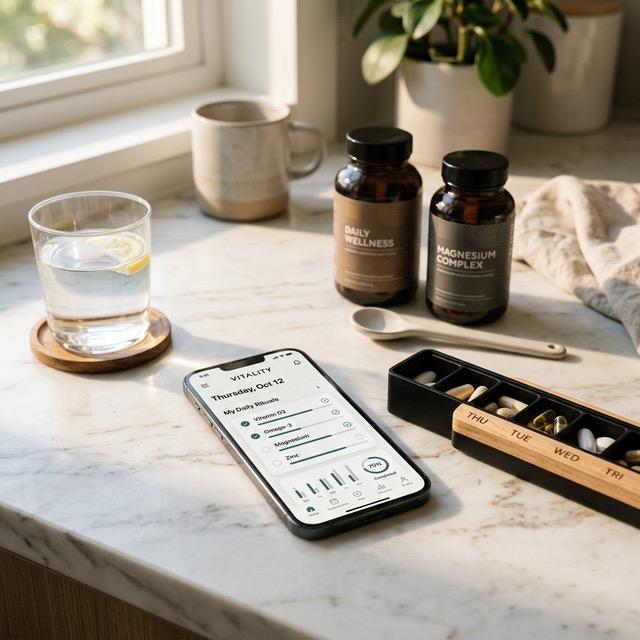
And once you've picked a product worth taking, consistency is what turns it into results. Use a supplement tracker to log your daily doses, set dose reminders, and notice which products are actually making a difference over weeks and months. A good label gets you a good supplement. A good routine turns it into a good outcome.