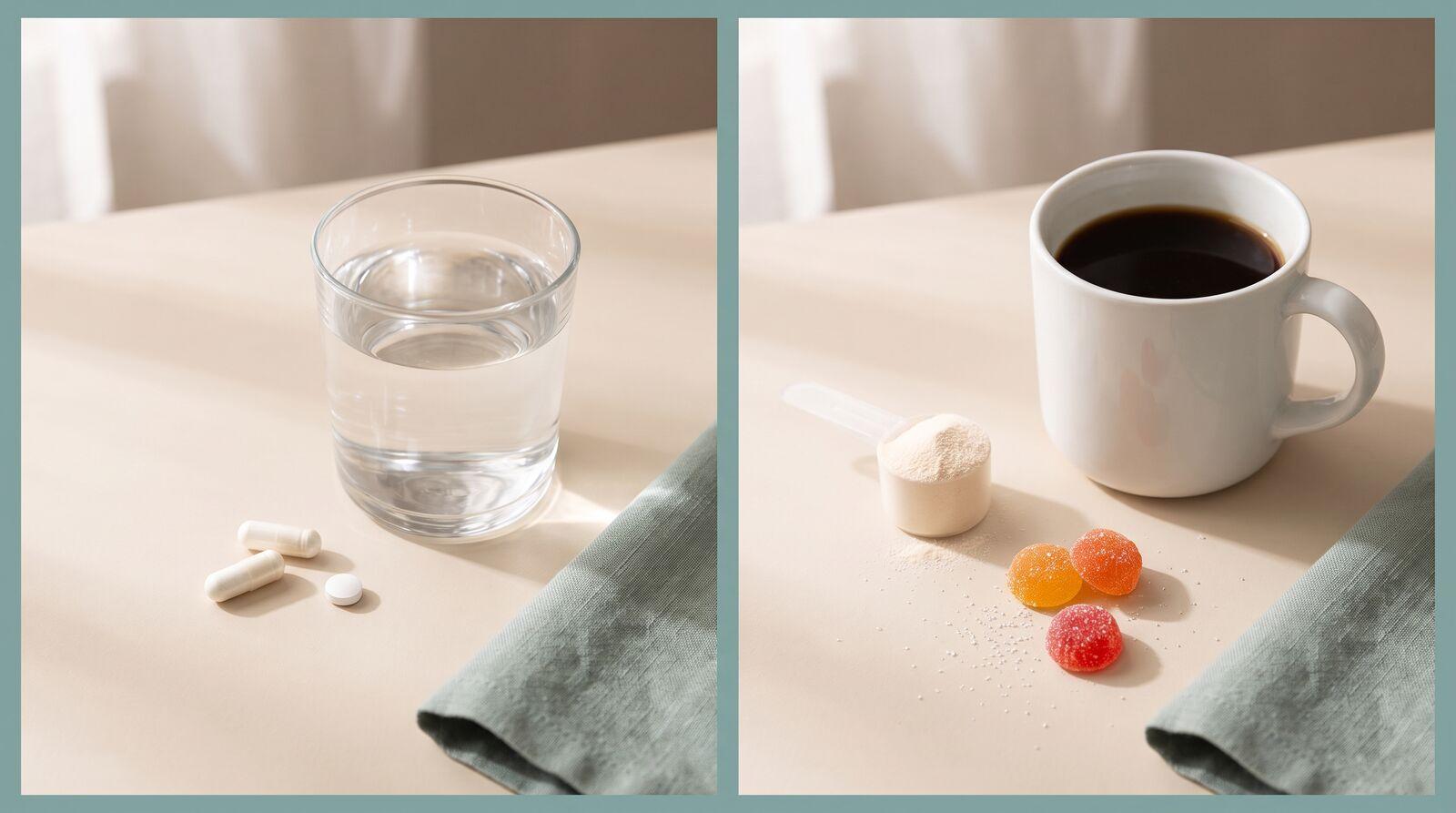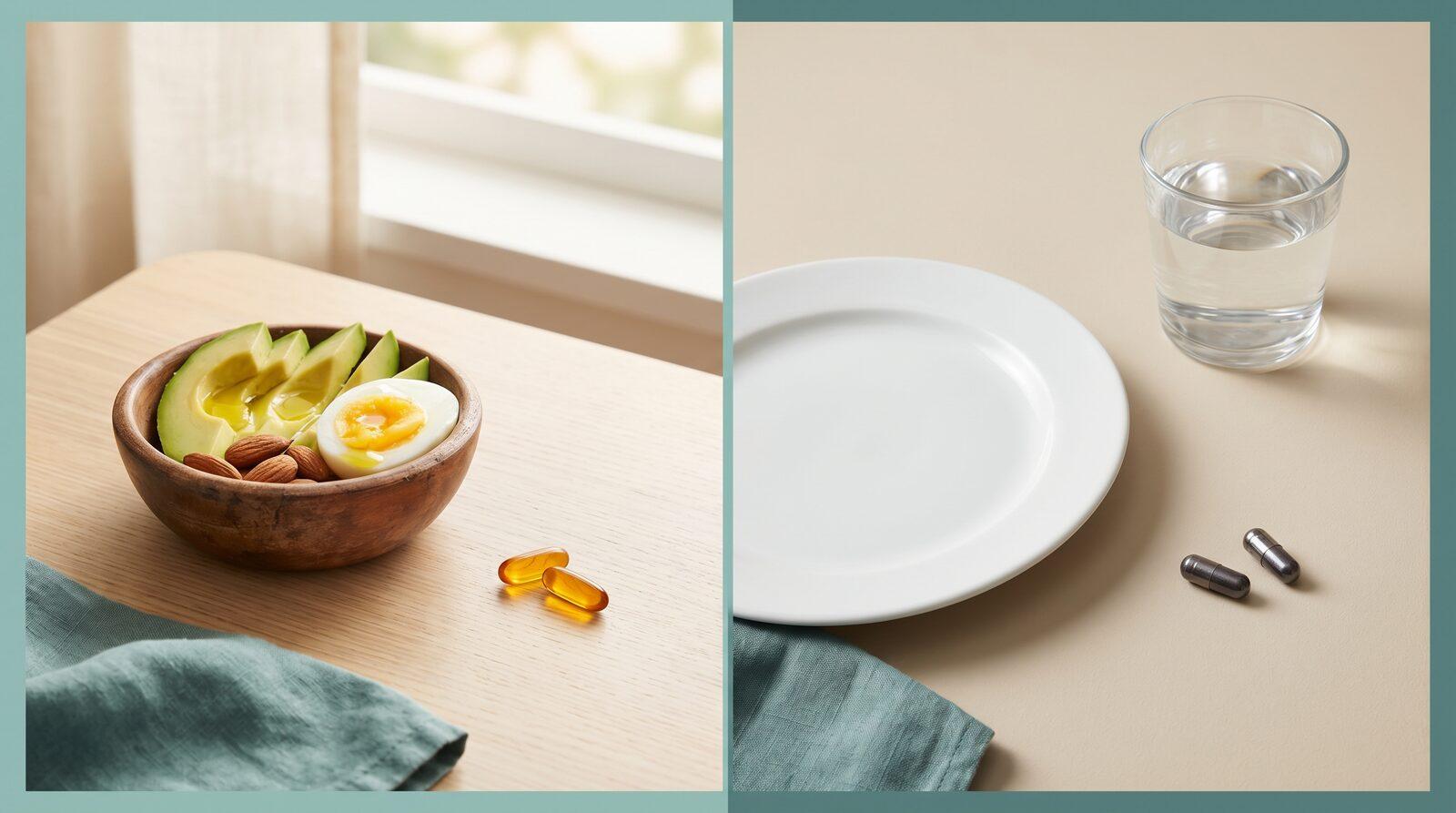
À prendre avec un aliment gras : vitamines D, E, A, K, CoQ10, oméga-3, curcumine/curcuma, ashwagandha (tous liposolubles ou mieux absorbés avec de la nourriture). À prendre avec un repas (n'importe lequel) : zinc, citrate de magnésium, fer (si le sulfate provoque des nausées), complexe B (pour éviter les nausées), créatine, collagène. À prendre à jeun : bisglycinate de fer (idéalement avec de la vitamine C, 30 à 60 min avant le repas), L-glutamine, glycine avant le coucher, probiotiques (ou juste avant un repas). Répartir les doses au cours des repas réduit les effets secondaires digestifs des minéraux.
Tu as acheté la bonne marque. Tu as choisi la bonne forme. Tu as même réglé un rappel quotidien. Mais il y a un détail qui détermine discrètement si la moitié de ton budget compléments arrive vraiment dans ta circulation sanguine : le fait de l'avoir pris au cours d'un repas ou à jeun.
Si vous cherchez encore quelle application adopter, notre guide des meilleures applications de suivi de compléments compare honnêtement les principales options.
Ce n'est pas un petit détail. Pour certains nutriments, prendre la même dose au petit-déjeuner plutôt qu'à jeun peut modifier l'absorption de 50 pour cent ou plus. Pour d'autres, le mauvais choix signifie un comprimé gaspillé, un estomac dérangé, ou les deux.
Voici le guide pratique, sans jargon, pour savoir quels compléments ont besoin de nourriture, lesquels exigent un estomac vide et lesquels s'en moquent un peu.
Pourquoi la nourriture (ou son absence) change l'absorption
Ton système digestif n'est pas un simple tuyau neutre. La présence de nourriture, de graisses, d'acidité gastrique et d'autres nutriments influence tous la manière dont un complément est décomposé, dissous et acheminé vers ta circulation sanguine.
Trois choses déterminent la question du "avec ou sans repas" :
- La liposolubilité. Les nutriments liposolubles ont littéralement besoin de graisses alimentaires pour être absorbés. Sans elles, une part importante de la dose te traverse sans servir à rien.
- L'acidité gastrique et l'irritation. Certains nutriments sont rudes pour un estomac vide. D'autres ont besoin d'un milieu acide pour se dissoudre, milieu que la nourriture peut diluer.
- La concurrence avec d'autres nutriments. Le calcium, le fer, le zinc et certains composés végétaux présents dans les aliments peuvent se lier à un complément et bloquer son absorption.
Une fois que tu as compris ces trois principes, toute la question du "quand le prendre" devient nettement plus simple.
Ceux-ci à prendre avec un repas (vitamines liposolubles et huiles)
Les vitamines liposolubles sont le cas le plus simple. Elles ne peuvent pas se dissoudre dans l'eau, alors elles font du stop jusqu'à ta circulation sanguine, accrochées aux graisses alimentaires. Pas de graisses dans le repas, absorption nettement réduite.
- Vitamine A (rétinol)
- Vitamine D3 (traitée en détail dans notre guide du meilleur moment pour prendre la vitamine D)
- Vitamine E
- Vitamine K1 et K2
- Oméga-3 huile de poisson, huile de krill et huile d'algues (pour les détails, voir notre guide de dosage des oméga-3)
- CoQ10 / Ubiquinol
- Curcumine / extraits de curcuma
- Astaxanthine
- Lutéine et zéaxanthine
Les graisses n'ont pas besoin d'être un festin. À peine 5 à 10 grammes de graisses dans un repas (pense à une cuillère à soupe d'huile d'olive, un demi-avocat, quelques noix, un œuf ou un petit morceau de fromage) suffisent à améliorer nettement l'absorption des vitamines liposolubles. Des études portant spécifiquement sur la vitamine D3 ont montré que l'absorption peut à peu près doubler lorsqu'elle est prise avec un repas contenant des graisses par rapport à un repas sans graisses.
Règle pratique : si un complément se présente sous forme de capsule molle, d'huile ou est étiqueté comme liposoluble, prends-le au repas de la journée qui contient le plus de graisses. Pour la plupart des gens, cela signifie le déjeuner ou le dîner, pas un café noir avec une tartine.
Ceux-ci à prendre avec un repas (pour ménager l'estomac)
Ces nutriments ne sont pas liposolubles, mais ils ont tendance à provoquer des nausées, des crampes ou des renvois lorsqu'ils sont pris à jeun. La nourriture agit comme un tampon.
Magnésium
Le glycinate de magnésium est généralement bien toléré, mais le citrate de magnésium, l'oxyde de magnésium et les doses élevées de n'importe quelle forme peuvent attirer l'eau dans l'intestin et provoquer des selles molles. La prise au cours d'un repas ralentit le transit et réduit l'effet laxatif. Si tu prends du magnésium pour dormir, prends-le plutôt au dîner qu'à jeun complet une heure avant le coucher. (Pour les différences entre les formes, voir notre comparaison glycinate de magnésium vs citrate de magnésium.)
Zinc
Le zinc à jeun est un déclencheur de nausées notoire. Beaucoup de gens constatent que même 15 à 30 mg sans nourriture dans l'estomac entraînent une vague de nausée en 20 minutes. Prends-le au cours d'un repas, et le problème disparaît généralement complètement. Le compromis, c'est que la nourriture (surtout riche en calcium) réduit légèrement l'absorption, mais une dose tolérable, un peu moins bien absorbée, vaut mieux qu'une dose parfaite que tu ne peux pas garder.
Vitamines du complexe B
Les vitamines B sont hydrosolubles, elles n'ont donc techniquement pas besoin de nourriture. Mais les produits de complexe B fortement dosés (surtout ceux contenant 50 mg ou plus de B6 ou de niacine) peuvent provoquer de légères nausées, des bouffées de chaleur ou des maux d'estomac à jeun. Les prendre au petit-déjeuner résout ce problème et présente l'avantage supplémentaire de s'accorder avec la dépense énergétique de la journée. Évite de prendre des vitamines B tard dans la journée, car elles peuvent être légèrement stimulantes pour certaines personnes.
Multivitamines
La plupart des multivitamines contiennent un mélange de nutriments liposolubles et hydrosolubles, ainsi que des minéraux qui peuvent irriter un estomac vide. Prends toujours une multivitamine au cours d'un repas. Si ta multivitamine demande de prendre plusieurs gélules par jour, répartis-les sur deux repas (petit-déjeuner et déjeuner) pour des taux sanguins plus stables et une digestion plus douce. (À consulter : as-tu vraiment besoin d'une multivitamine ?)
Créatine monohydrate
La créatine n'a pas strictement besoin de nourriture, mais la prendre au cours d'un repas contenant des glucides et des protéines peut aider l'absorption musculaire en déclenchant une réponse insulinique. C'est aussi plus doux pour l'estomac de cette façon. La créatine simple dans de l'eau à jeun convient à la plupart des gens, mais les estomacs sensibles s'en sortent mieux avec de la nourriture.
Ceux-ci à prendre à jeun
Ces compléments sont soit nettement mieux absorbés sans nourriture, soit bloqués par des nutriments courants dans les repas.
Fer
Le fer est l'exemple type. Pris à jeun (idéalement dès le matin ou entre les repas), l'absorption du fer est environ 2 à 3 fois plus élevée que lorsqu'il est pris au cours d'un repas. Les deux grands bloqueurs d'absorption sont :
- Le calcium (produits laitiers, laits végétaux enrichis, suppléments de calcium)
- Les polyphénols et les tanins (café, thé, vin rouge, chocolat noir)
Une routine matinale de fer avec café et yaourt revient pour ainsi dire à jeter le fer. Les règles :
- Prends le fer au moins 1 heure avant le repas, ou 2 heures après.
- Associe-le à un petit verre de jus d'orange ou à 200 mg de vitamine C : l'acide ascorbique transforme le fer non héminique en une forme plus assimilable et peut multiplier l'absorption par 2 à 3.
- Attends au moins 2 heures avant de consommer du calcium, du café ou du thé.
- Si le fer te dérange l'estomac, change de forme (le bisglycinate de fer est bien plus doux que le sulfate ferreux) avant d'abandonner.
Probiotiques
Le moment idéal pour les probiotiques fait débat, mais les preuves les plus solides plaident pour les prendre soit :
- 30 minutes avant un repas, lorsque l'acidité gastrique est plus faible et que davantage de bactéries survivent au trajet jusqu'à l'intestin, soit
- juste avant le coucher sur un estomac relativement vide.
Prendre des probiotiques en plein milieu d'un gros repas acide les expose à un maximum d'acidité gastrique, tuant un pourcentage plus élevé des cultures vivantes avant qu'elles n'atteignent les intestins.
Compléments d'acides aminés (BCAA, EAA, glutamine)
Les acides aminés libres sont absorbés le plus rapidement en l'absence de protéines alimentaires concurrentes. Si tu prends des BCAA ou des acides aminés essentiels autour de l'entraînement, prends-les à jeun (ou au moins 2 heures après un repas contenant des protéines) pour obtenir le pic d'acides aminés plasmatiques le plus rapide.
Peptides de collagène
Le collagène peut techniquement être pris au cours d'un repas, mais la plupart des gens préfèrent le prendre à jeun pour qu'il n'entre pas en concurrence avec d'autres protéines lors de la digestion. Le mélanger dans le café du matin ou dans un verre d'eau avant le petit-déjeuner est une routine populaire.
L-théanine, ashwagandha et la plupart des adaptogènes
Ceux-ci n'ont pas strictement besoin d'un estomac vide, mais ils ont tendance à agir plus vite et de façon plus perceptible lorsqu'ils sont pris sans protéines alimentaires concurrentes. La L-théanine à jeun fait effet en 20 à 30 minutes ; avec un repas copieux, l'effet est plus lent et plus doux. L'ashwagandha se prend souvent le soir avant le coucher, ce qui tombe naturellement sur un estomac plus léger.
Ça dépend (compléments dépendant du contexte)
Certains compléments fonctionnent dans les deux cas, mais avec des compromis.
Vitamine C
La vitamine C est hydrosoluble et s'absorbe bien dans les deux contextes. Deux raisons pour lesquelles certaines personnes préfèrent parfois la prendre à jeun :
- Une concentration plasmatique maximale plus élevée (pic plus rapide)
- Une synergie avec la supplémentation en fer (les prendre ensemble à jeun)
Deux raisons de la prendre au cours d'un repas :
- Les doses élevées (1 000 mg et plus) peuvent provoquer des diarrhées ou des problèmes d'acidité gastrique chez les personnes sensibles
- L'associer à des repas contenant des aliments végétaux riches en fer (épinards, lentilles, haricots) augmente l'absorption du fer de ces aliments
Si tu prends une dose faible à modérée (moins de 500 mg), à jeun convient très bien. Pour les doses plus élevées ou les estomacs sensibles, prends-la au cours d'un repas.
Calcium
Le calcium s'absorbe mieux en petites doses (moins de 500 mg à la fois) et un peu mieux au cours d'un repas. Mais le plus gros problème avec le calcium, c'est le moment de prise par rapport aux autres minéraux : ne le prends jamais en même temps que le fer ou le zinc, car le calcium bloque les deux. Si tu prends du calcium, réserve-le à un repas qui ne contient pas ces minéraux (généralement le dîner).
Caféine et pre-workouts
La caféine à jeun fait effet plus vite (15 à 30 minutes) et frappe plus fort. Avec de la nourriture, l'effet est plus lent et plus doux, avec moins de risque de tremblements ou de problèmes d'acidité gastrique. Les estomacs sensibles bénéficient au moins d'un petit en-cas au préalable. (Pour combiner caféine et L-théanine, voir notre guide du stack L-théanine et caféine.)
L'aide-mémoire de référence rapide
| Complément | Avec repas ? | Pourquoi |
|---|---|---|
| Vitamine A, D, E, K | Oui, avec des graisses | Liposoluble |
| Oméga-3 / Huile de poisson | Oui, avec des graisses | Liposoluble ; réduit les renvois de poisson |
| CoQ10 | Oui, avec des graisses | Liposoluble |
| Curcumine | Oui, avec des graisses | Sinon mauvaise absorption |
| Magnésium | Oui (ou en-cas léger) | Réduit l'effet laxatif |
| Zinc | Oui | Estomac vide provoque des nausées |
| Complexe B | Oui | Prévient les nausées |
| Multivitamine | Oui | Mélange de nutriments, plus doux pour l'intestin |
| Fer | Non (à jeun) | La nourriture bloque l'absorption |
| Probiotiques | Non (avant repas ou coucher) | L'acidité gastrique tue les cultures |
| BCAA / Acides aminés | Non | Pic d'acides aminés plus rapide |
| Collagène | Les deux | Souvent pris à jeun par commodité |
| L-théanine / Ashwagandha | Les deux (souvent à jeun) | Effet plus rapide |
| Vitamine C | Les deux | Les deux fonctionnent ; dépend de la dose |
| Calcium | Oui | Mieux toléré avec de la nourriture |
Les erreurs courantes qui sabotent discrètement ta routine
- Prendre le fer avec le café du matin. Le café peut réduire l'absorption du fer de jusqu'à 60 pour cent. Déplace le fer dans une fenêtre séparée.
- Prendre la vitamine D avec un café noir. Pas de graisses signifie une fraction de l'absorption que tu devrais obtenir. Prends-la au repas le plus gras de la journée.
- Empiler le calcium et le fer dans la même dose. Ils sont en concurrence directe. Sépare-les d'au moins 2 heures.
- Avaler le magnésium à jeun 30 minutes avant le coucher. Provoque souvent des selles molles qui te réveillent à 2 heures du matin. Prends-le plutôt au dîner.
- Prendre des mégadoses de vitamines liposolubles un matin sans graisses. Une capsule de vitamine D3 à 5 000 UI avec une tranche de pain grillé sec est en grande partie gaspillée.
Comment construire une routine "avec repas / sans repas"
La plupart des gens n'ont pas besoin de micro-gérer chaque dose. Un cadre simple qui fonctionne pour la majorité des stacks :
- À jeun (le matin, avant le café) : fer + vitamine C, ou probiotiques
- Petit-déjeuner : multivitamine, complexe B, vitamine C (si tu la prends séparément)
- Repas le plus copieux de la journée (déjeuner ou dîner) : vitamine D3 + K2, oméga-3, CoQ10, vitamine E, tout autre liposoluble
- Dîner : magnésium, zinc (si tu en prends), calcium (s'il est séparé du fer)
- Avant le coucher (estomac plus léger) : glycinate de magnésium (si pas au dîner), L-théanine, ashwagandha, mélatonine
C'est tout. Cinq catégories, et presque tous les compléments que tu croiseras se rangent proprement dans l'une d'elles.
Suis ce qui fonctionne vraiment pour ton corps
Les règles d'absorption te donnent un point de départ, mais ton estomac est unique. Certaines personnes tolèrent le fer avec un tout petit en-cas. D'autres ont des nausées avec le zinc quoi qu'elles mangent. Le seul moyen d'affiner, c'est d'être attentif.
Pendant deux semaines, note non seulement ce que tu as pris, mais aussi quand et avec quoi (à jeun, en-cas léger, repas complet). Note tout problème digestif, tremblement ou effet perceptible. Les schémas émergent vite.
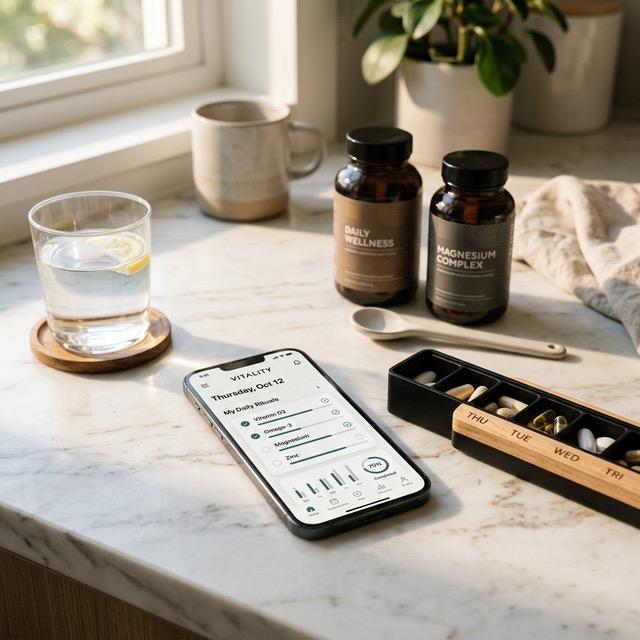
Un suivi des compléments rend cela trivial : associe chaque dose à son contexte horaire, note comment tu t'es senti après, et laisse l'historique parler de lui-même. Une fois que tu as trouvé la routine à laquelle ton corps réagit vraiment, les mêmes compléments que tu prends depuis toujours commencent à donner des résultats nettement meilleurs, sans dépenser un euro de plus.
Le bon complément, sous la bonne forme, à la bonne dose, pris au mauvais moment avec le mauvais repas, n'est qu'une habitude coûteuse. Le bon complément au bon moment, c'est ce que ton corps attendait.