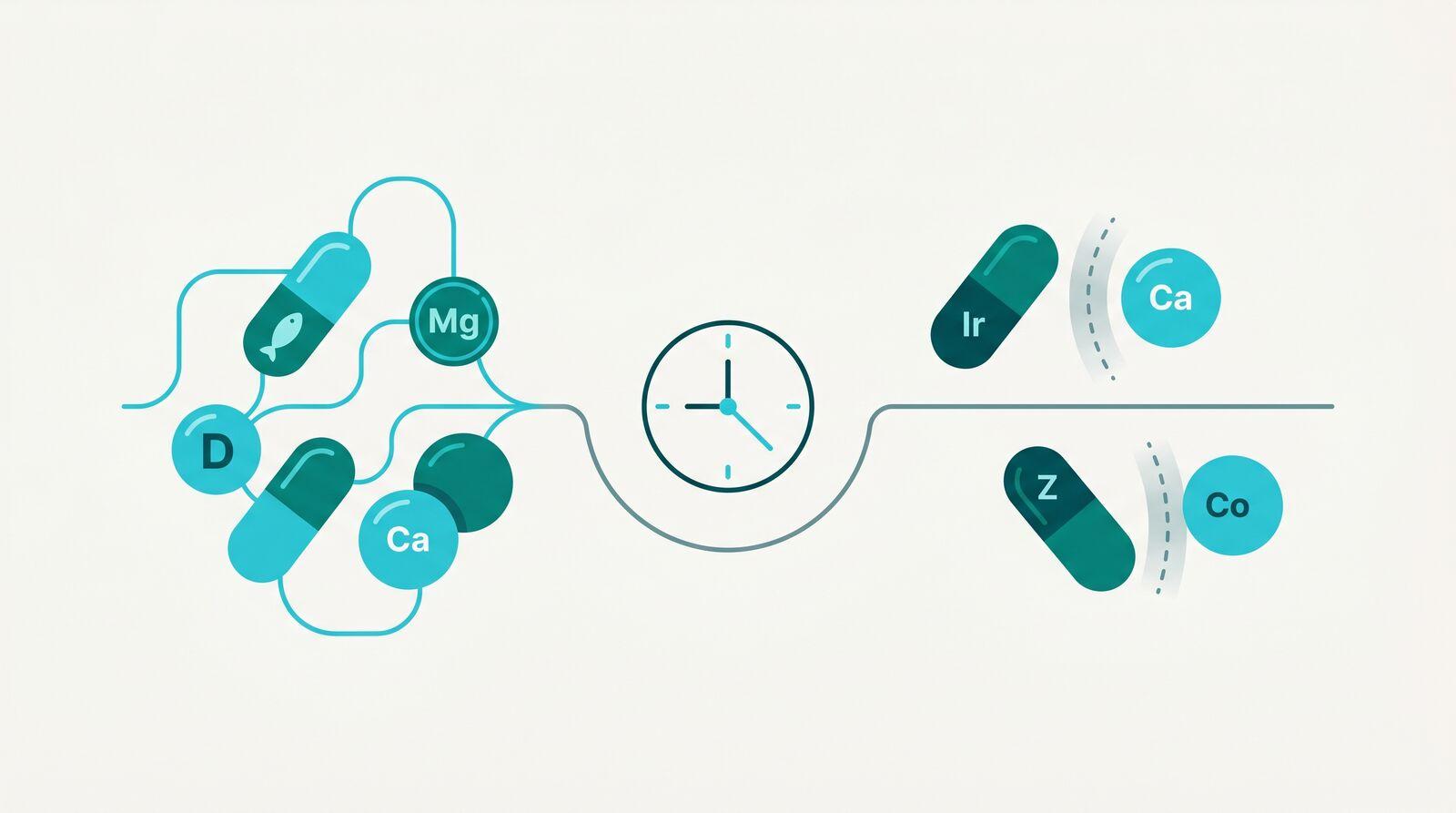
Do not take together: calcium + iron (calcium blocks non-heme iron absorption by 60%); zinc + iron (compete for DMT1 transporter); zinc + calcium (high calcium reduces zinc); turmeric + iron (curcumin chelates iron); coffee or tea + iron (tannins inhibit). Take together (synergistic): vitamin C + iron (6x absorption boost); vitamin D3 + K2 (calcium routing); D3 + magnesium (magnesium activates D); B12 + folate (homocysteine). Space antagonistic pairs 2+ hours; pair synergistic ones at the same meal.
Most people build a supplement routine the way they build a playlist: add whatever sounds good and hit play all at once. Calcium, iron, zinc, magnesium, a multivitamin, maybe a greens powder, all swallowed together with breakfast because that is the one moment of the day you remember. It feels efficient. It is often the reason half of those supplements are doing nothing.
The uncomfortable truth is that supplements are not independent. They compete for the same transport proteins, the same absorption windows, the same chemistry in your gut. Take the wrong two together and one of them wins while the other passes straight through you. Take the right two together and they amplify each other. The difference between a routine that works and one that quietly wastes money is rarely the products. It is usually the spacing.
This is the evidence-based guide to which supplement pairs fight, which pairs help, and how to schedule the conflicting ones so each actually gets absorbed.
Why Supplement Interactions Are Mostly an Absorption Problem
When people hear "supplement interaction" they imagine something dramatic and dangerous. For the vast majority of common supplements, the real interaction is far more boring and far more expensive: competitive absorption.
Many minerals are absorbed in the small intestine through shared transport pathways. Iron, zinc, calcium, magnesium, and copper are chemically similar enough that they ride some of the same transporters and binding proteins. When you flood the gut with a large dose of one, it occupies most of the available transport capacity, and the others get crowded out. Nothing toxic happens. You just absorb a fraction of what you paid for.
This is why the question "what supplements should I not take together" almost never has a safety answer for healthy adults taking normal doses. It has an efficiency answer. The cost of getting it wrong is not a hospital visit. It is months of taking iron that never raised your ferritin, or calcium that never reached your bones, because it was always swallowed alongside its direct competitor.
The exceptions, the genuinely safety-relevant interactions, are mostly between supplements and prescription medications, and those are covered at the end. The day-to-day money-wasters are the mineral conflicts.
Before you commit to one app, it's worth reading our honest comparison of supplement tracker apps.
The Pairs That Cancel Each Other Out
These are the combinations where taking them together meaningfully reduces absorption of one or both. Space them by the recommended gap and both work; take them together and you are underdosing one of them.
| Pair | What happens | How to fix it |
|---|---|---|
| Calcium + Iron | Calcium is the single biggest blocker of non-heme iron absorption. A high calcium dose can cut iron uptake substantially in the same meal. | Separate by at least 2 hours. Iron on an empty stomach or with vitamin C, calcium at a different meal. |
| Zinc + Copper | Chronic high-dose zinc (40 mg or more daily) without copper drives a real copper deficiency over weeks to months. This one is not just absorption, it is depletion. | If supplementing zinc long-term above 25 mg, add 1 to 2 mg copper, taken at a separate time. |
| Zinc + Iron | In large single doses taken together on an empty stomach, they compete and both absorb worse. | Separate by 2 hours, or take with food, which blunts the competition. |
| Calcium + Magnesium | Large doses of each compete for absorption. The interaction is modest at typical supplement doses but real at high doses (500 mg or more of each). | Split them across morning and evening rather than one large combined dose. |
| Calcium + Zinc | High-dose calcium reduces zinc absorption, especially on an empty stomach. | Separate by 2 hours if both are individually dosed. |
| Iron + Green tea / coffee | Polyphenols and tannins in tea and coffee bind non-heme iron and sharply reduce its absorption. | Keep iron at least 1 to 2 hours away from tea or coffee. |
| Iron + Zinc + Calcium in one multivitamin | A "complete" multivitamin packs all three together, so the highest-dose mineral wins and the others underperform. | This is why isolated iron or zinc, taken away from a multivitamin, often works when the multivitamin alone did not. |
The headline offenders are calcium and high-dose zinc. Calcium is the bully of the mineral world: it interferes with iron, magnesium, and zinc when taken in the large doses found in standalone calcium supplements. High-dose zinc is the slow saboteur: the copper depletion it causes builds silently and is one of the more common avoidable supplement-induced deficiencies.
A practical rule that covers most of these: never take a standalone calcium supplement at the same time as a standalone iron or zinc supplement. That single habit removes most of the meaningful conflicts in a typical routine.
The Pairs That Actually Help Each Other
Spacing is not the whole story. Some combinations are synergistic, and separating them is the mistake. These belong together.
| Pair | Why they work together |
|---|---|
| Iron + Vitamin C | Vitamin C reduces iron to a more absorbable form and counteracts some absorption inhibitors. Taking iron with a vitamin C source or supplement measurably increases uptake. This is the single most useful "take together" pairing. |
| Vitamin D + Vitamin K2 | D raises calcium absorption; K2 helps direct that calcium into bone rather than soft tissue and arteries. They are functionally a team, which is why they are sold together. See why D3 and K2 belong together. |
| Vitamin D + Magnesium | Magnesium is a required cofactor in the enzymes that activate vitamin D. Low magnesium blunts the benefit of vitamin D supplementation, so they support each other. |
| Fat-soluble vitamins (A, D, E, K) + dietary fat | These are not absorbed well without fat in the same meal. Taking them with a fat-containing meal substantially improves uptake. This is timing, not a conflict. |
| Calcium + Vitamin D | D is required for efficient calcium absorption, which is the one case where calcium plays nicely, with the right partner. |
The pattern here is worth internalizing: minerals tend to fight each other, but vitamins frequently unlock or direct minerals. Vitamin C unlocks iron. Vitamin D unlocks calcium. Vitamin K2 directs that calcium. Magnesium activates vitamin D. The synergies are nearly as important as the conflicts, and separating a synergistic pair out of caution is just as wasteful as combining a competing one out of convenience.
The Fat-Soluble Vitamin Question
Vitamins A, D, E, and K are fat-soluble, and there is a persistent worry that they compete with each other the way minerals do. The evidence here is much softer.
At normal supplemental doses, A, D, E, and K do not meaningfully block each other. The one interaction with reasonable support is that very high-dose vitamin E can interfere with vitamin K activity, which matters mainly for people on blood thinners. For everyone else taking ordinary doses, the practical advice is simpler: take all of them with a meal containing some fat, and do not megadose any single one. The bigger fat-soluble risk is not interaction, it is accumulation, since these vitamins are stored rather than excreted, so chronic megadosing of A or D carries real toxicity risk that water-soluble vitamins do not.
A Realistic Two-Slot Schedule
You do not need a spreadsheet with hourly alarms. Almost every common conflict resolves with a simple two-slot split: a morning group and an evening group, with the competing minerals placed in opposite slots.
A workable default for someone taking the common stack:
- Morning, with breakfast: Iron (with a vitamin C source), B vitamins, vitamin D with K2 if your meal has some fat. Keep coffee and tea away from this slot by an hour or two if iron is in it.
- Evening, with dinner or before bed: Calcium, magnesium, zinc. This keeps calcium and zinc far from the morning iron, and magnesium in the evening suits its mild relaxing effect.
If you also take a complete multivitamin, treat it as its own event and keep standalone iron away from it, because the multivitamin's calcium and zinc will throttle the iron. The recurring theme across taking supplements with food versus on an empty stomach and interaction spacing is the same: when something works matters as much as whether you take it.
The minimum viable rules, if you remember nothing else:
- Standalone calcium goes far from standalone iron and zinc. At least 2 hours.
- Iron pairs with vitamin C, not with coffee, tea, or calcium.
- Long-term high-dose zinc needs companion copper, dosed separately.
- Fat-soluble vitamins go with a meal that contains fat.
- Vitamin D, K2, and magnesium are allies, not competitors. Keep them in the routine together.
Supplement and Medication Interactions: The Part That Is Actually About Safety
Everything above is about wasted money. This section is about risk, and it works differently. Several common supplements interact with prescription drugs in ways that are clinically meaningful, not just inconvenient:
- Vitamin K and warfarin. Vitamin K directly opposes warfarin. Large or fluctuating vitamin K intake destabilizes anticoagulation. This requires medical coordination, not self-management.
- Calcium, magnesium, iron, and zinc with certain antibiotics and thyroid medication. These minerals bind drugs like levothyroxine and some antibiotics in the gut and block their absorption. The fix is the same spacing logic, usually a 4-hour separation, but the stakes are higher than a wasted supplement.
- St. John's Wort with almost everything. It induces drug-metabolizing enzymes and reduces the effectiveness of many medications, including some that are critical.
- High-dose fish oil, vitamin E, or other supplements with anticoagulants and antiplatelets. A mild additive effect on bleeding risk that is worth flagging to a prescriber.
The rule for this category is different from the efficiency rules above. With minerals competing for absorption, the worst case is a supplement that does not work. With supplement and drug interactions, the worst case is a medication that does not work, or works too well. If you take any prescription medication, the spacing question is one for your pharmacist, not a blog.
You Cannot Optimize What You Do Not Track
Here is the practical problem with everything above: interaction effects are invisible in the moment. You will never feel calcium blocking your iron. You will never notice zinc slowly depleting your copper. There is no symptom at the point of the mistake, only an outcome months later, like an iron supplement that never moved your ferritin or a deficiency that crept in while you were technically supplementing for it.
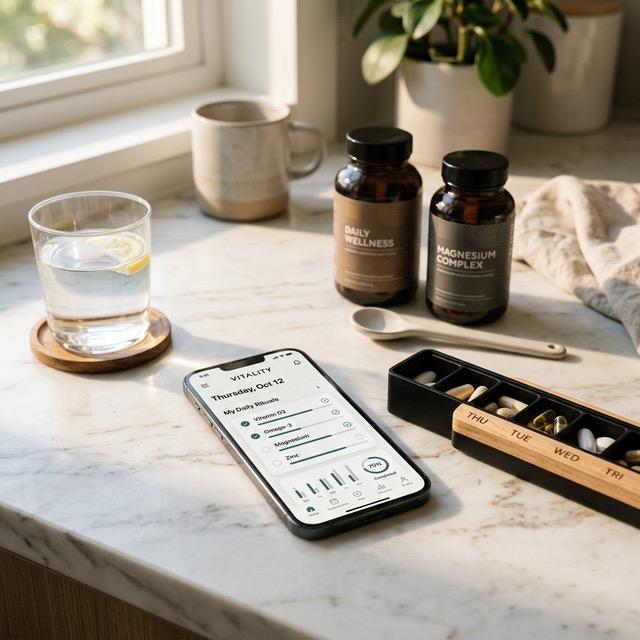
That is exactly why a tracking habit is the thing that makes interaction knowledge useful instead of academic. To get this right you need to know not just what you took but when, and to be able to look back and see that your iron and calcium have been quietly riding in the same morning dose for three months. A simple log that records the time of each supplement, not just a daily checkbox, turns "I think I take these separately" into something you can actually verify. Tracking supplements consistently is what converts a two-slot schedule from a good intention into a routine you can confirm is being followed, and it is the same discipline that makes iron supplementation actually raise your levels instead of disappearing into a cup of morning coffee.
The supplements themselves are rarely the weak link. The schedule is. Get the spacing right, keep the synergistic pairs together, separate the competitors by a meal, and let a log prove you are actually doing it. That alone will make an existing routine work better than any new product you could add to it.
This article is for educational purposes and does not constitute medical advice. Supplement and medication interactions can be clinically significant. Talk to a qualified healthcare provider or pharmacist before combining supplements with prescription medications, especially anticoagulants, thyroid medication, or antibiotics.