Greens powders are the wellness aisle's most photogenic product: a scoop of dried vegetables, fruits, algae, probiotics, adaptogens, and vitamins that promises to cover the nutritional gaps in a modern diet. The honest state of the evidence is that almost none of that promise has been tested. Very few randomized trials exist on any specific greens powder, and the ones that do are small, short, and often funded by the brand selling the product. What is well established is far more mundane: the vitamins and minerals added to these blends are absorbed like any other supplement, so a greens powder is, at its core, a very expensive multivitamin with some fiber and plant extracts alongside it. The central problem is the proprietary blend. Most labels list a long, impressive ingredient list under a single combined weight, which legally hides how much of each ingredient you actually get. In practice the flashy botanicals, mushrooms, and probiotics are usually present in doses far too small to do what their standalone research suggests, a phenomenon the industry calls fairy dusting. Greens powders do have legitimate uses: they are convenient, they can genuinely help someone who eats almost no vegetables get a baseline of micronutrients, and many people find the routine itself valuable. What they cannot do is replace vegetables, because they lack the volume of fiber and the food matrix of a real plate of produce, and they do not undo an otherwise poor diet. At 79 to 99 dollars a month for the premium brands, the real question is not whether a greens powder does something, but whether it does 80 dollars more than a 10 dollar multivitamin plus actual vegetables. For most people the answer is no. If you like the ritual and can afford it, it is a harmless luxury. If you are buying it to fix your diet, the money is better spent on the diet.
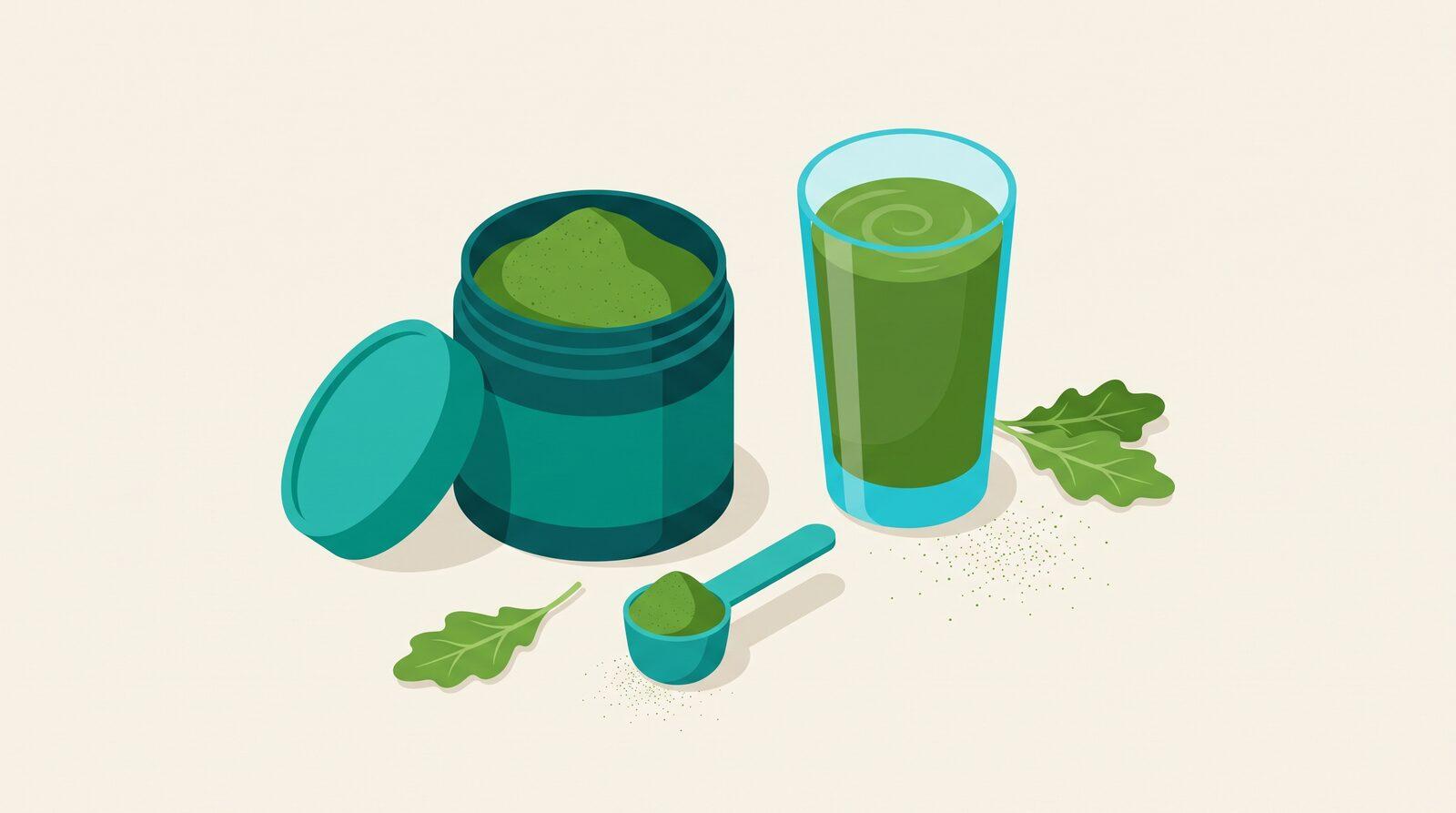
A scoop of green powder swirls into a glass of water, turns a vivid grassy color, and the promise on the pouch is enormous: dozens of superfoods, adaptogens, probiotics, and antioxidants in one daily ritual that stands in for the vegetables you never quite eat. Athletic Greens, now sold simply as AG1, built an entire category on that pitch, and a dozen competitors have copied it. The imagery is always the same: vitality, wellness, one simple habit that quietly fixes everything else.
The category is unusually hard to evaluate because it is not selling one thing, it is selling forty things at once, which makes it almost impossible to say what, if anything, is working. This guide separates what greens powders genuinely are from what the marketing implies, looks at the surprisingly thin research behind them, explains the proprietary-blend trick that makes the long ingredient list misleading, and gives you an honest way to decide whether the price is buying you anything a much cheaper routine would not.
What a Greens Powder Actually Is
Strip away the branding and a typical greens powder is a blend of a few distinct categories mixed into one scoop:
- Dried vegetable and fruit powders: spinach, kale, broccoli, beet, and similar, dehydrated and milled.
- Algae and grasses: spirulina, chlorella, wheatgrass, barley grass, which give the product its color and its "superfood" language.
- Added vitamins and minerals: often a full or near-full spectrum, which is where most of the measurable nutritional value actually comes from.
- Probiotics and digestive enzymes: bacteria strains and enzymes added in small amounts.
- Adaptogens and botanicals: ashwagandha, rhodiola, mushroom extracts, and other trendy ingredients.
Read that list honestly and a greens powder looks less like a magic food and more like a multivitamin with fiber and a scattering of plant extracts stirred in. That is not an insult, but it does reframe the price. Much of what your body reliably gets from the scoop is the synthetic and mineral fraction, which behaves exactly like the same nutrients in a ordinary multivitamin costing a fraction as much.
If you're still deciding which app to trust with your routine, our guide to the best supplement tracker apps compares the leading options honestly.
What the Evidence Actually Shows
Here is the part the marketing never leads with: there is very little published research on greens powders as products.
A supplement like creatine or omega-3 has hundreds of human trials on a single, well-defined molecule. A greens powder is a proprietary mixture of dozens of ingredients, and mixtures are hard and expensive to study. The result is that for most branded greens powders, the number of independent, randomized, controlled human trials is close to zero. The studies that do exist tend to be small, short, and funded by the company that makes the product, which is the weakest tier of evidence there is.
This does not mean the individual ingredients are worthless. Spinach, kale, and berries are good for you, and that is not in dispute. The problem is the leap from "these foods are healthy" to "this powder made from tiny amounts of these foods delivers those benefits." That leap has not been demonstrated. When researchers have tested greens-type blends, the measurable effects have mostly been on blood markers you would expect any vitamin supplement to move, not the sweeping wellness outcomes the packaging implies.
The accurate summary is the same one that fits a lot of premium supplements: the ingredients are real, the doses are the question, and the marketing is running well ahead of the data.
The Proprietary Blend Problem
This is the single most important thing to understand before you buy any greens powder, and it is the reason the long ingredient list is less impressive than it looks.
Most greens powders list their ingredients inside a proprietary blend: a long roster of components followed by one combined weight, for example "Super Greens Blend, 8g." Legally, that lets the company hide how much of each individual ingredient is in the scoop. You can see that spirulina, ashwagandha, and a probiotic are present. You cannot see whether the ashwagandha is a research-backed 300 to 600 mg or a token 20 mg included mainly so it can appear on the label.
In practice, it is almost always the token amount. The industry nickname for this is fairy dusting or pixie-dusting: adding a sprinkle of a fashionable ingredient so the marketing can name it, at a dose far below what the standalone research on that ingredient actually used. A greens powder might proudly list a dozen adaptogens and mushrooms, and the combined total of all of them might be less than a single proper dose of any one.
So when you compare a greens powder to the studies on its headline ingredients, remember you are almost never getting the studied dose. You are getting a taste of it, wrapped in a blend that is engineered to look comprehensive.
What Greens Powders Do Well
None of this makes greens powders a scam, and it is worth being fair about where they genuinely earn their place:
- Convenience is real. One scoop, mixed in seconds, is genuinely easier than assembling a balanced plate, and for some people easy is the difference between doing something and doing nothing.
- They can raise a rock-bottom baseline. Someone who eats almost no fruit or vegetables and takes no other supplement will get a meaningful micronutrient floor from a greens powder. That is a low bar, but a real benefit for the people actually standing under it.
- The ritual has value. A daily habit that makes someone feel they are taking care of themselves can nudge other behaviors in a good direction, and that psychological effect is not nothing.
- They are generally safe. For healthy adults, greens powders are low-risk. The main cautions are that they often contain more than the recommended amount of some vitamins if you are also taking a multivitamin, and that ingredients like added vitamin K or certain botanicals can interact with medication, so anyone on blood thinners or prescription drugs should check the full label with a doctor.
What They Cannot Replace
The central marketing claim, that a scoop stands in for vegetables, is where the product oversells hardest.
A serving of greens powder contains a few grams of material. A single cup of real spinach or broccoli contains far more total plant matter, water, and above all fiber, which greens powders provide in only trivial amounts. Fiber is one of the genuinely important things most people are short on, and it is the thing a powder is least able to deliver; if that is your goal, a dedicated fiber supplement or, better, actual plants will do far more.
Whole vegetables also come as a food matrix: the fiber, water, and thousands of compounds arriving together in a form your gut evolved to handle. Drying, milling, and reassembling a fraction of that into a scoop is not the same input, and no honest reading of the science treats it as equivalent. A greens powder alongside a decent diet is a supplement. A greens powder instead of vegetables is a downgrade dressed as an upgrade.
Is It Worth the Money?
This is where the decision actually lives. Premium greens powders run roughly 79 to 99 dollars a month on subscription, which puts them among the most expensive items in anyone's supplement routine.
The useful comparison is not "greens powder versus nothing," because at that comparison it looks fine. The honest comparison is "greens powder versus what the same money buys elsewhere." A plain third-party-tested multivitamin costs a few dollars a month and delivers the reliable part of what a greens powder delivers: the vitamins and minerals. Add actual fruit and vegetables and a fiber source, and you have reproduced everything a greens powder does that is supported by evidence, with the fiber and food matrix it cannot match, for a small fraction of the price. Our roundup of cheap supplements that actually work makes the same point across the whole aisle: the proven ingredients are rarely the expensive ones.
That reframes the 80-dollar question. You are not paying 80 dollars for nutrients you cannot get otherwise. You are paying it for convenience, taste, and the ritual. Those are legitimate things to value, and if you enjoy the routine and the budget is comfortable, a greens powder is a harmless luxury. If you are buying it under the belief that it is repairing a poor diet or replacing produce, you are paying a premium for a promise the evidence does not back.
How to Decide, and What to Buy Instead
A practical way through it:
- If your diet is already reasonable, a greens powder adds little you need. The vegetables are doing the work; the powder is a garnish on top at premium prices.
- If you eat very few vegetables, the honest first move is a cheap multivitamin plus a real effort to add produce and fiber, not an 80-dollar powder that lets you feel the problem is solved without solving it.
- If you still want one for convenience, shop smart: prefer products that disclose individual ingredient doses rather than hiding them in a proprietary blend, look for third-party testing, and be skeptical of any label whose main selling point is the sheer length of the ingredient list.
The best greens powder for most people is the one they do not need to buy, because the alternative is cheaper, better evidenced, and already in the produce aisle.
Track Whether It Actually Does Anything
Greens powders are unusually good at producing a feeling of wellness that is hard to pin to anything measurable, which is exactly why they are easy to keep paying for. The promise is diffuse: more energy, better digestion, general vitality, all things expectation alone can manufacture for a few weeks, especially at this price.
If you decide to try one, run it as an honest experiment rather than a vibe. Pick two or three concrete measures before you start, such as afternoon energy on a fixed 1 to 10 scale, digestion, or how consistently you actually take it, and log them daily. Change nothing else at the same time. Give it 8 to 12 weeks, then read the record instead of your memory. A supplement tracker turns "I think I feel a bit better" into something you can actually see, and for a product this expensive, being able to tell whether anything changed is worth more than another month of assuming it did.
The Bottom Line
Greens powders are real food powders with real vitamins, sold with claims that run far past the evidence. The nutrients they reliably provide are the ones a cheap multivitamin also provides; the fashionable botanicals are usually fairy-dusted below useful doses inside a proprietary blend; and the core promise, replacing vegetables, is the one thing a scoop cannot do. They are convenient, generally safe, and occasionally useful for someone whose diet has no floor at all.
For most people the accurate verdict is that a greens powder is an expensive convenience, not a nutritional necessity. Buy it if you value the ritual and can afford it. Do not buy it believing it fixes a diet that vegetables, a basic multivitamin, and a bit of fiber would fix better and cheaper.
This article is for educational purposes and does not constitute medical advice. Greens powders can contain high doses of certain vitamins and botanicals that interact with medication, so anyone on prescription drugs, including blood thinners, or who is pregnant or breastfeeding should review the full label with a qualified healthcare provider before starting one.