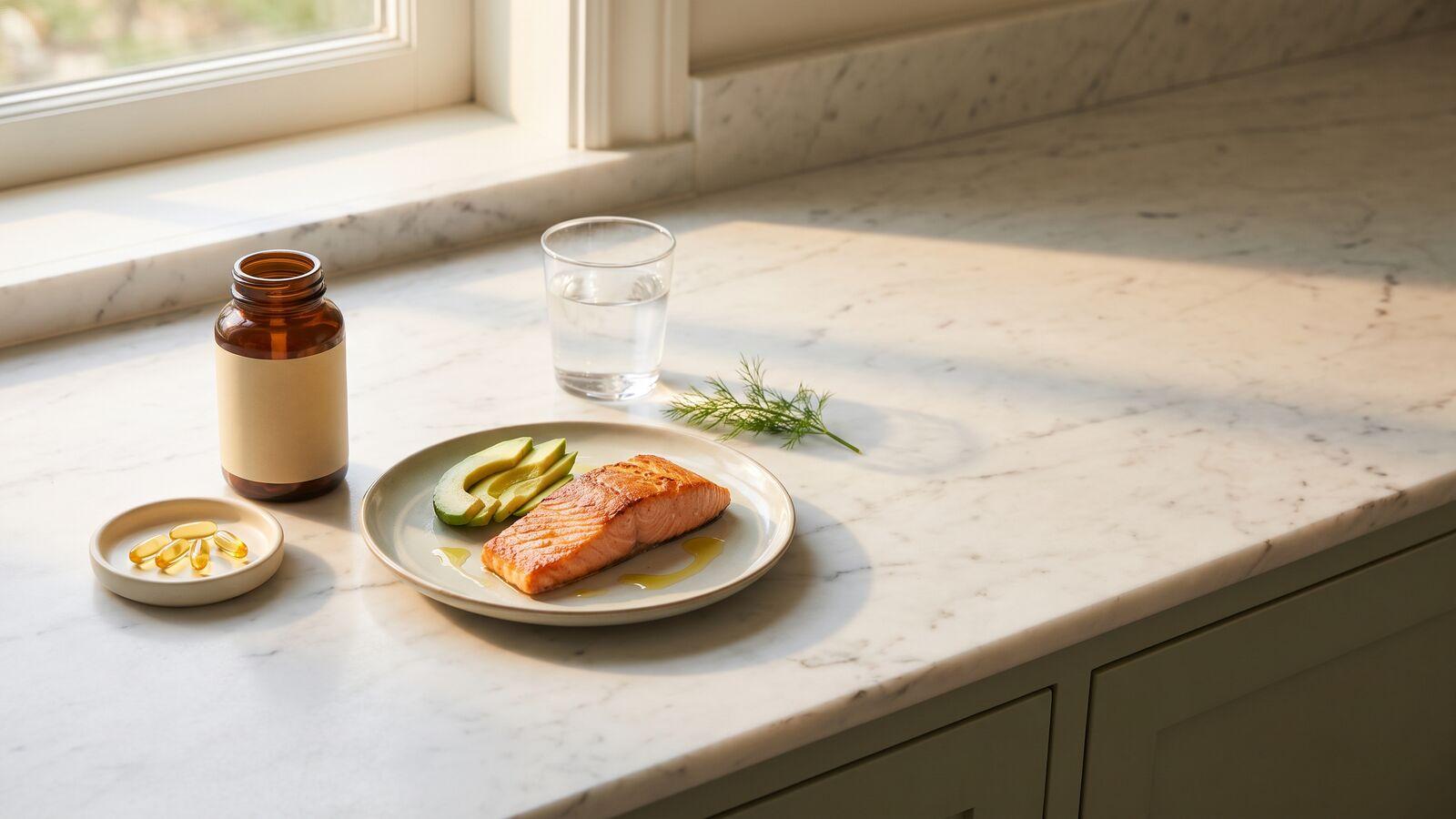
The best time to take fish oil is with the meal of the day that has the most fat, at whatever hour you can repeat every day. We found no trial comparing morning and evening doses on any outcome, and omega-3 levels in the blood build over weeks, so the clock matters little. The meal matters more for some capsules than others. In two small 1988 absorption studies, ethyl ester fish oil was absorbed about three times better with a 44 g fat meal than with an 8 g fat meal, while natural triglyceride oil depended less on the meal. A 2012 crossover study funded by a competing manufacturer found that a prescription ethyl ester product lost most of its absorption on low-fat days. These are short absorption studies, not health outcomes. Check the label for 'ethyl esters' or 'triglyceride form', take it at the start of a meal, and split large doses across two meals if they cause burps. If you take a blood thinner, ask your clinician before starting.
Most fish oil bottles say "take with food." Few say which food, and almost none say that the answer depends on what kind of oil is inside the capsule. Search for the best time to take fish oil and you will be told to take it at night because it "matches your inflammation cycle," or in the morning so you do not forget. We looked for trials behind both and found none.
Here is the short answer: take fish oil with the meal of the day that has the most fat, at an hour you can repeat every day. The clock matters very little. The meal matters more than most guides admit, and for one common type of capsule it matters a lot.
The Short Answer: The Meal Beats the Clock
Two things make time of day a weak lever for fish oil.
First, omega-3s work through levels that build slowly. In an 18-month controlled study by Katan and colleagues, 58 men took 0 to 9 g of fish oil a day. EPA in the blood's cholesteryl esters reached a plateau after 4 to 8 weeks, and EPA in red blood cell membranes took about 180 days to reach a steady state. A dose at 8 a.m. versus 8 p.m. is unlikely to change a level that moves over weeks and months.
Second, we found no trial comparing morning and evening fish oil on any outcome: not blood levels, not triglycerides, not joint pain, not sleep. The claim that evening doses "align with inflammatory cycles" appears in search summaries without a study behind it.
What does have data behind it is the meal. EPA and DHA are fats. Ethyl esters in particular need pancreatic lipase, a digestive enzyme that a fatty meal stimulates, as the ECLIPSE researchers put it. That is why the fat content of the meal you take it with can change how much you absorb, and why the form on the label decides how much that matters.
Check Your Label, Then Pick Your Meal
Fish oil supplements contain omega-3s in several chemical forms. The NIH Office of Dietary Supplements (ODS) lists natural triglycerides, ethyl esters, re-esterified triglycerides, free fatty acids and phospholipids. Ethyl esters are made from natural fish oil by swapping its glycerol backbone for ethanol; re-esterified triglycerides are ethyl esters converted back. ODS sums up the research this way: triglycerides, re-esterified triglycerides and free fatty acids have somewhat higher bioavailability than ethyl esters, but all forms significantly raise blood EPA and DHA.
This table pulls together what the absorption studies cited in this article show for each form.
| What the label says | Form | How much the fat in your meal matters | Practical slot |
|---|---|---|---|
| "Ethyl esters," "EE," "omega-3-acid ethyl esters" (also prescription Lovaza-type capsules) | Ethyl ester | A lot. Absorption roughly tripled with a 44 g fat meal compared with an 8 g fat meal in one small study | Your fattiest meal of the day, never with black coffee alone |
| "Triglyceride form," "rTG," "re-esterified triglycerides" | Re-esterified triglyceride | Less than ethyl esters, per ODS; no meal-fat study of its own found | Any meal with some fat |
| "Fish oil" or "fish body oil" with modest EPA+DHA (around 300 mg per 1,000 mg capsule) | Natural triglyceride | Some. In the same study, EPA absorption rose from 69% to 90% with the high-fat meal; DHA did not change significantly | Any meal with some fat |
| "Krill oil" | Mostly phospholipids | Unclear; ODS says some studies suggest higher bioavailability than fish oil and others do not | Any meal |
| "Algal oil," "algae omega-3" | Typically triglyceride, per ODS | No meal-fat study found | Any meal with some fat |
If the label names no form, ask the brand: the label or the manufacturer is the only reliable answer. The facts panel also tells you how much EPA and DHA you actually get; our omega-3 dosage guide shows how to read it.
Why the Meal Matters More for Ethyl Ester Capsules
The table rests on three small studies. All three measured absorption over hours, not health, and two were run by companies with a stake in the result.
- Lawson and Hughes, 1988 (low-fat meal). In a study of eight men, single doses were taken with a low-fat meal. Compared with free fatty acids, natural triglyceride EPA and DHA were absorbed 68% and 57% as well, and ethyl esters only 20% and 21% as well.
- Lawson and Hughes, 1988 (high-fat meal). In a follow-up, the same researchers repeated the test with a meal containing 44 g of fat instead of 8 g. Absorption of ethyl ester EPA and DHA rose about threefold, to roughly 60%. Natural triglyceride EPA rose from 69% to 90%, and DHA did not change significantly. Both papers came from a pharmaceutical company lab and tested men only.
- ECLIPSE, 2012. In a crossover study of 54 overweight adults, single 4 g doses of a prescription ethyl ester product (Lovaza) were taken during low-fat and high-fat periods. On low-fat days, only 3 of 50 participants kept at least half of the absorption they had on high-fat days. The study was funded by the maker of a competing free fatty acid product, which performed better.
One newer trial is a useful counterweight. In a 2021 randomized crossover study of 22 adults who took about 1.2 g of EPA and DHA with low-fat meals, ethyl ester and triglyceride forms did not differ in blood levels over 24 hours. So the size of the form gap is not settled.
What holds across these studies is narrower and more useful: if your capsule is an ethyl ester, a low-fat meal is the worst time to take it. None of these studies shows that one form leads to better heart, brain or joint outcomes, and we do not claim it. Taking any form with a fat-containing meal costs nothing and sidesteps much of the question. For a broader look at which supplements need food, see supplements with food vs an empty stomach.
Fish Oil: Morning or Night?
Once fish oil is paired with a meal, morning versus night is a practical choice, not a biological one. A few trade-offs help decide.
- Your largest meal. A Mayo Clinic internist recommends taking fish oil before your largest meal of the day when you can. For many people that is dinner, which also fits ethyl ester capsules.
- Breakfast that is mostly coffee. A black coffee and a piece of fruit is close to a fat-free meal. If that is your breakfast, the morning slot works against ethyl ester capsules. Move them, or add something with fat.
- Heartburn. ODS lists heartburn and nausea among the common side effects. If you get reflux in the evening, some people find taking fish oil with lunch, rather than late dinner just before lying down, more comfortable. This is a comfort tip, not a tested rule.
- Remembering. A dose you take at the same meal every day beats a perfectly timed dose you miss twice a week.
The claims that night-time fish oil "prevents morning heart attacks" or "fights inflammation while you sleep" have no trial behind them that we could find. If a routine built around one of them works for you, keep it, but do not treat it as a reason to move a dose that is already working.
If you are building a full routine, our morning supplement stack and evening supplement stack show how to group products by slot.
Fish Burps and Reflux: What Helps
Burping and a fishy aftertaste are the most familiar fish oil complaint. The prescribing information for Lovaza, a prescription ethyl ester product, lists eructation (burping), indigestion and taste changes as its most common side effects. ODS also lists unpleasant taste, bad breath and heartburn.
Commonly suggested fixes, with an honest note on the evidence:
- Take it at the start of a meal, so the capsule mixes with food rather than sitting on top of it. This is a common tip without a dedicated trial.
- Split the dose. If you take several capsules, one or two with each of two meals is easier on the stomach for many people. The Lovaza label itself allows the 4 g daily dose as one dose or as two capsules twice a day.
- Try enteric-coated capsules, which are designed to dissolve past the stomach. We found no trial showing that they reduce burps, so treat this as worth trying, not proven.
- Freezing capsules is a popular trick. In the only randomized test we found, a 30-day pilot study of 60 healthy adults taking fish oil frozen, with food, with milk or on an empty stomach found no difference in self-reported side effects or adherence. Freezing does no harm to try, but do not expect much.
Switching form is not a sure fix either: in the 2021 crossover study above, burping and aftertaste were similar across ethyl ester, triglyceride and monoglyceride capsules. If burps make you skip doses, our comparison of krill oil vs fish oil covers whether the pricier krill route is worth it.
Splitting Doses, Prescription Omega-3 and Blood Thinners
For a standard one-capsule dose, splitting is pointless. It makes sense in three cases:
- Several capsules a day, especially concentrates, when one large dose causes burps or stomach upset.
- An ethyl ester product and two fat-containing meals, so each part of the dose has fat to work with.
- Prescription omega-3. Lovaza's label says it was given with meals in clinical studies, as one 4-capsule dose or two capsules twice daily, swallowed whole. Follow your prescription and your prescriber, not a general guide.
How many capsules you need is a separate question that depends on the EPA and DHA per capsule and your reason for taking it; our omega-3 dosage guide walks through it.
If you take warfarin, another anticoagulant or an antiplatelet drug, or have surgery coming up, ask your clinician before starting or changing fish oil. The details are in our page on fish oil and blood thinners.
Pairing Fish Oil With Your Other Supplements
- Vitamin D: also absorbed better with a fat-containing meal, so the same meal works for both. See the best time to take vitamin D.
- Other fat-soluble supplements (vitamins A, E and K) can share the slot too.
- Your omega-3 profile: forms, sources and typical amounts are on our omega-3 page.
Make the Routine Stick
The best time to take omega-3 is a meal you never skip. Supplement Tracker lets you put fish oil in a time-of-day slot with its own reminder, tied to the meal you chose, and check off each dose, so a missed week shows up before your next blood test rather than after.
Frequently Asked Questions
Can I take fish oil on an empty stomach?
You can, and some of it will still be absorbed. But in small absorption studies, ethyl ester fish oil was absorbed far less with a low-fat meal than with a high-fat one, so an empty stomach is the weakest slot, especially for concentrates.
Is it better to take fish oil in the morning or at night?
Neither has been shown to be better. Choose the meal with the most fat that you eat every day. For many people that is dinner, but breakfast works if it contains some fat.
Can I take fish oil with coffee?
We found no evidence that coffee interferes with fish oil. The problem is that a coffee-only breakfast has almost no fat, which matters most for ethyl ester capsules. Take it with food that contains fat.
How many fish oil capsules should I take a day?
It depends on the EPA and DHA per capsule and why you take it. A typical 1,000 mg capsule contains about 300 mg of EPA plus DHA, according to ODS. Our omega-3 dosage guide explains how to read the label.
How long does fish oil take to work?
Blood levels change over weeks, not hours. In one controlled study, EPA in the blood plateaued after 4 to 8 weeks of daily use, and red blood cell levels took about six months to stabilize. Our guide to how long supplements take to work covers what to expect.
Does freezing fish oil capsules ruin them?
We found no evidence that it harms the oil, and no strong evidence that it helps: one small pilot study found frozen capsules caused no fewer side effects than other methods.
This article is general information, not medical advice. If you take prescription medication, are pregnant, or have a diagnosed condition, ask your doctor or pharmacist before changing your supplements.