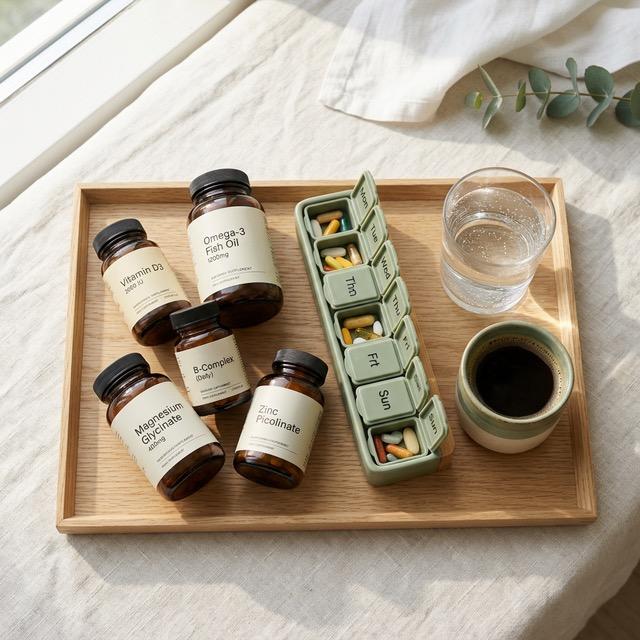
Most supplements do not break a fast, but the ones that do are the ones people take most casually. What breaks a fast is calories and the insulin response they trigger, not the act of swallowing something, so the question is almost never about the nutrient and almost always about the delivery format. Plain capsules and tablets carry a trivial amount of filler, usually well under five calories, and are fine fasted: B vitamins, vitamin C, magnesium, zinc, potassium, unsweetened electrolytes, creatine monohydrate, caffeine, L-theanine, melatonin, and herbal capsules like ashwagandha or rhodiola all pass. The clear breakers are the ones with sugar or protein in them: gummy vitamins carry two to four grams of sugar per serving, collagen and protein powder deliver amino acids that raise insulin and blunt autophagy, BCAA and EAA powders do the same more sharply, and greens powders, apple cider vinegar gummies, chewables, and MCT oil all carry real calories. A third group is more subtle. Fat-soluble vitamins A, D, E, and K, plus omega-3, CoQ10, and curcumin, will not meaningfully break a fast, but taking them fasted wastes them, because absorption can drop by half or more without dietary fat. Move those to your eating window for absorption reasons, not fasting reasons. Iron is the one supplement that genuinely prefers the fasting window, absorbing roughly two to three times better without food, coffee, tea, or calcium competing with it. On fasts longer than about twenty-four hours, electrolytes stop being optional: falling insulin tells the kidneys to dump sodium, and the resulting losses drive the headaches, cramps, and fatigue people blame on the fast itself. The one fast where nothing is negotiable is a blood draw, where biotin in hair-and-nail products can skew troponin and thyroid immunoassays badly enough that the FDA has issued a safety communication about it.
You set a reminder for 7 a.m. and your eating window does not open until noon. So every morning you stand in the kitchen holding a handful of capsules and a glass of water, running the same calculation: does this count? Is the fish oil fine? What about the collagen in the coffee? The gummy that tastes suspiciously like candy?
Before you commit to one app, it's worth reading our honest comparison of supplement tracker apps.
The internet answers this badly. Half the articles say vitamins never break a fast, the other half hand you a list of forbidden items with no reasoning behind it, and almost none of them acknowledge that the answer depends on what you are fasting for. The good news is that the underlying rule is simple and you can apply it to any product on your shelf, including ones nobody has written about.
Here is the honest version: most supplements do not break a fast, a specific and predictable group does, and a third group technically does not but is being wasted anyway.
First, Define What You Are Fasting For
"Breaking a fast" is not one thing, and this is where most of the confusion comes from. There are four different fasts people run, and they have different thresholds.
Fasting for calorie control. If your goal is eating less over the day, only calories matter. A capsule with two calories of filler is irrelevant. A scoop of collagen at forty is a rounding error for some people and a broken rule for others, depending on how strict they want to be with the habit.
Fasting for metabolic effect. If the point is keeping insulin low, what matters is whether something triggers an insulin response. Carbohydrates do this most sharply, protein and free amino acids do it meaningfully, and fat barely does at all. This is the standard most intermittent fasters are actually operating under, whether or not they would describe it that way.
Fasting for autophagy. The strictest and least well-defined standard. Autophagy is the cellular recycling process that fasting is supposed to upregulate, and protein, particularly the amino acid leucine, is what signals the body to switch it off. Worth knowing: almost all of the specific autophagy timing you see quoted online comes from animal studies, and the human evidence for precise thresholds is thin. If this is your goal, be conservative about anything containing amino acids, but do not treat the numbers as precise.
Fasting for a blood test. Different category entirely, with real medical consequences. Covered further down, because the rules are not the same and getting it wrong can distort results your doctor is about to act on.
For the rest of this article, the default assumption is the metabolic standard: no meaningful calories, no insulin response.
The Rule That Covers Almost Everything
The nutrient is rarely the problem. The delivery format almost always is.
Vitamin D does not break a fast. Vitamin D in a gummy does, because the gummy is candy with vitamin D in it. Creatine does not break a fast. Creatine in a flavored, sweetened pre-workout might. The same molecule can sit on either side of the line depending on what it was mixed with to make it palatable.
So the practical test is not "is this a vitamin" but three quick label checks:
- Look at the calories per serving. Under about five is negligible under any standard. Anything in the double digits is a real ingestion.
- Read the "Other Ingredients" line. This is where sugar, glucose syrup, maltodextrin, sorbitol, fruit juice concentrate, and gelatin hide. It is also where the calories that never made it onto the front of the label live.
- Ask whether it contains protein or free amino acids. Even calorie-light amino acid products punch above their weight, because they signal the body directly.
That is it. Three checks, and you can classify anything.
Supplements That Do Not Break a Fast
These are safe under a calorie or metabolic standard. Plain capsules and tablets typically contain a gram or less of filler such as cellulose, rice flour, or magnesium stearate, which works out to a handful of calories at most and no insulin response worth measuring.
- B vitamins and B-complex. Water-soluble, no calories, absorbed fine without food. The only caveat is tolerance, covered below.
- Vitamin C. Same story. Ascorbic acid on an empty stomach absorbs well and peaks fast.
- Magnesium, zinc, potassium, selenium, iodine. Minerals in capsule or tablet form are calorie-free.
- Unsweetened electrolyte powders. Check the label, because plenty are sweetened, but a genuinely unsweetened sodium, potassium, and magnesium blend is fine, and on longer fasts it is more than fine, it is necessary.
- Creatine monohydrate. Plain, unflavored creatine has no calories and does not raise insulin. The common worry that creatine breaks a fast comes from confusing it with the sweetened powders it is usually sold inside. On its own it passes, and the full case for it is in our complete guide to creatine.
- Caffeine and L-theanine. Both calorie-free in capsule form, and the combination is a standard fasted-morning pairing. See our guide to the L-theanine and caffeine stack for dosing.
- Melatonin. Tablets and capsules are fine. Melatonin gummies are not, and gummies are how most melatonin is now sold, so check.
- Herbal capsules. Ashwagandha, rhodiola, turmeric extract, milk thistle, saw palmetto: extracts in capsules carry no meaningful calories.
- Most probiotic capsules. Watch for products that add prebiotic fiber or inulin in gram quantities, which is a small carbohydrate load, but a standard probiotic capsule is fine.
Black coffee, plain tea, and water are all uncontroversial here, with the caveat that adding milk, cream, or sweetener moves them into the next section.
Supplements That Break a Fast
These carry real calories, a real insulin response, or both. If you are fasting for anything beyond the loosest calorie standard, move them into your eating window.
Gummy vitamins. The single most common mistake. A gummy multivitamin typically carries two to four grams of sugar and ten to fifteen calories per serving, and people often take two or three. It is a small piece of candy. There is a second reason to be skeptical of them beyond fasting, which we covered in are gummy vitamins effective.
Collagen peptides. The most common accidental fast-breaker, because "collagen in my morning coffee" is marketed as a fasting-compatible ritual and it is not. A standard ten-gram scoop is roughly thirty-five to forty calories of protein, and protein raises insulin and signals against autophagy. Under a strict standard it breaks the fast. Our collagen supplement guide covers whether it is worth taking at all.
Protein powder of any kind. Whey, casein, soy, pea: all protein, all insulinogenic, all calorie-bearing. This is the least ambiguous item on the list.
BCAAs and EAAs. Free amino acids are absorbed fast and hit the relevant signaling pathways harder per calorie than intact protein does. Popular in fasted training circles precisely because the calories look small, but by a metabolic or autophagy standard they are among the worst offenders.
Greens powders and superfood blends. Real plant material in real quantities means real calories and carbohydrates, usually twenty to fifty per scoop. Our greens powder analysis covers the rest of the story.
Apple cider vinegar gummies. All the sugar of a gummy vitamin with a splash of vinegar.
MCT oil, butter, and "keto" fat supplements. These are the interesting edge case. Fat produces little insulin response, so bulletproof-coffee advocates argue it preserves the metabolic state, and there is something to that. But a tablespoon of MCT oil is roughly a hundred calories, which is unambiguously eating. It preserves ketosis, it does not preserve a fast.
Chewables, liquid supplements, and syrups. Chewable vitamin C, liquid vitamin D drops in a sweetened base, elderberry syrup: all sugar-delivered. Sugar-free versions using sugar alcohols like sorbitol or maltitol are lower impact but not zero, and they cause enough digestive complaints on an empty stomach to be worth avoiding anyway.
The Ones That Do Not Break It, But You Are Wasting Anyway
This is the group nobody warns you about, and it is the most expensive mistake on the list.
Fat-soluble vitamins cannot dissolve in water. They need dietary fat to get into your bloodstream, and a fasting window has no dietary fat in it by definition. Taking them fasted will not break your fast in any meaningful way, since a softgel contains about a gram of oil. It will just waste a meaningful fraction of the dose.
Move these to a meal in your eating window:
- Vitamin D3 (absorption can roughly double when taken with a fat-containing meal, as covered in our guide to the best time to take vitamin D)
- Vitamin K2, which is usually paired with D3 anyway
- Vitamins A and E
- Omega-3, fish oil, krill oil, and algae oil
- CoQ10 and ubiquinol
- Curcumin and turmeric extracts
- Most multivitamins, which contain fat-solubles plus minerals that irritate an empty stomach
The rule is simple: if it is a softgel, an oil, or labeled fat-soluble, it belongs with the fattiest meal of your eating window. The full breakdown of what needs food and what does not is in our guide to supplements with food vs empty stomach.
Iron Actually Prefers Your Fasting Window
One supplement genuinely benefits from being taken fasted, and most people are doing it wrong.
Iron absorbs roughly two to three times better on an empty stomach than with a meal, and its two biggest blockers, calcium and the polyphenols in coffee and tea, are exactly what most people consume in the morning. A fasting window is a clean, uncontested absorption window, and it is arguably the best thing intermittent fasting does for a supplement routine.
The practical rules: take iron with water, not coffee. Pair it with vitamin C, which converts non-heme iron into a more absorbable form. Keep it at least two hours away from any calcium, which includes the dairy or fortified plant milk that shows up the moment your eating window opens, as covered in can you take iron and calcium together. And if fasted iron makes you nauseous, switch to iron bisglycinate before you give up on the timing, because it is far gentler than ferrous sulfate. Who actually needs supplemental iron in the first place is a separate and important question, answered in iron supplements: who needs them.
Electrolytes Stop Being Optional on Longer Fasts
On a 16:8 schedule this barely matters. On fasts past roughly twenty-four hours it matters a lot, and it is the single most common reason people conclude that fasting does not agree with them.
The mechanism is straightforward. Insulin tells the kidneys to hold on to sodium. When you fast, insulin falls, and the retention signal falls with it, so the kidneys start excreting sodium along with the water it holds. Potassium and magnesium follow. The result is the classic package of fasting complaints: headache, lightheadedness on standing, muscle cramps, flat energy, and a heart that feels like it is working harder than it should. People attribute all of that to the fast. Most of it is sodium.
The fix is unsweetened electrolytes with real sodium content, taken through the fasting window rather than at the end of it. Read the label carefully, because a large share of electrolyte products are sweetened with sugar or dextrose, which puts you right back in the previous section. What to look for and how much you actually need is covered in do you need electrolyte supplements.
One caveat worth stating plainly: fasts beyond about twenty-four hours are not a casual undertaking, especially if you take blood pressure medication, diuretics, insulin, or any glucose-lowering drug. That is a conversation with a clinician, not a supplement question.
Empty Stomach Is a Tolerance Problem Too
A supplement can be perfectly fast-compatible and still be a bad idea fasted, because your stomach gets a vote.
Zinc is the worst offender. Fifteen to thirty milligrams on a completely empty stomach produces a wave of nausea in a lot of people within twenty minutes. It does not break a fast. It may well end your morning.
High-potency B-complex, especially products with fifty milligrams or more of B6 or niacin, can cause nausea or flushing without food to buffer it.
Magnesium citrate and oxide pull water into the gut. On an empty stomach that laxative effect arrives faster and harder. Glycinate is much gentler if you want magnesium in your fasting window.
Iron, as above, is worth persevering with because the absorption gain is real, but switching forms beats pushing through nausea.
If a fast-compatible supplement makes you feel awful fasted, the answer is usually to move it to the eating window rather than to endure it. Absorption you cannot tolerate is not absorption.
The One Fast Where Nothing Is Negotiable
A fast before a blood draw is a different animal, and supplements can distort results in ways that lead to real medical decisions.
The headline case is biotin. It is in most hair, skin, and nail products, often at doses hundreds of times the daily requirement, and it interferes with a wide range of immunoassays because many of them rely on biotin-streptavidin binding chemistry. The FDA issued a safety communication about this in 2017 and reiterated it in 2019, singling out cardiac troponin, where falsely low results could mean a missed heart attack. Thyroid tests, hormone panels, and hCG are also affected, in either direction depending on the assay. Our biotin guide covers why the hair-growth claims are weak in the first place.
Biotin is not alone. High-dose vitamin C can interfere with some glucose and occult blood assays, and B vitamins can affect certain panels. The safe default before a blood test is water only, and biotin specifically stopped several days beforehand. Tell whoever ordered the test what you take, including the products you do not think of as drugs. This is also the one context where "it is just a vitamin" causes actual harm.
Quick Reference
| Supplement | Fasted? | Why |
|---|---|---|
| B vitamins, vitamin C | Yes | No calories, water-soluble |
| Magnesium, zinc, potassium | Yes | Calorie-free minerals |
| Creatine monohydrate (plain) | Yes | No calories, no insulin response |
| Caffeine, L-theanine | Yes | Calorie-free |
| Melatonin (tablet) | Yes | Gummy version does not qualify |
| Herbal capsules | Yes | Extracts carry no meaningful calories |
| Unsweetened electrolytes | Yes | Necessary on longer fasts |
| Iron | Yes, ideally | Absorbs 2 to 3x better fasted |
| Vitamin D3, K2, A, E | Technically, but no | Needs dietary fat to absorb |
| Omega-3, CoQ10, curcumin | Technically, but no | Same, move to a meal |
| Multivitamin | No | Fat-solubles plus stomach irritation |
| Gummy vitamins | No | 2 to 4 g sugar per serving |
| Collagen peptides | No | ~35 to 40 kcal, raises insulin |
| Protein powder | No | Calories plus insulin response |
| BCAAs, EAAs | No | Amino acid signaling, blunts autophagy |
| Greens powders | No | 20 to 50 kcal, real carbohydrates |
| MCT oil, keto fats | No | ~100 kcal per tablespoon |
A Schedule That Works for 16:8
Most people running a standard eating window do not need to take anything fasted at all. The window is long enough to fit everything, and putting supplements with meals solves absorption and tolerance in one move.
During the fast (optional): iron with vitamin C and water, electrolytes if you feel flat, caffeine and L-theanine, creatine.
First meal: multivitamin, B-complex, vitamin C, probiotics just before eating.
Largest meal of the window: vitamin D3 and K2, omega-3, CoQ10, curcumin, vitamin E. Anything fat-soluble goes here.
Later in the window or before bed: magnesium glycinate, ashwagandha, melatonin, zinc with the last meal.
That is four buckets, and almost everything you own fits into one of them. If your eating window is unusually short, which is common for anyone on appetite-suppressing medication, compressing supplements into fewer, larger doses can cause its own problems with tolerance and absorption competition, something we covered in supplements on GLP-1 medications. Building the fasted portion into a repeatable sequence is the same exercise as building any morning supplement stack, just with a narrower set of eligible items.
Track It Rather Than Guessing
Fasting and supplementation are two variables that people almost always change at the same time, which is exactly how you end up unable to explain your own results. You start a 16:8 schedule, move four supplements around to fit it, add electrolytes, and two weeks later you feel different without knowing which change did it.
Change one thing at a time. Move your fat-soluble vitamins to your largest meal and hold everything else constant for two weeks. Then add electrolytes to the fasting window and see whether the mid-morning slump goes away. Then try iron fasted and see whether tolerance holds. Log what you took, when you took it, and whether it landed inside or outside the eating window, and the answers arrive on their own. That is precisely the discipline described in tracking supplements consistently, and a tracker with per-dose timing makes the fasted-versus-fed distinction something you can actually see in your history rather than reconstruct from memory.
The short version: swallowing a capsule is not eating. Swallowing candy shaped like a capsule is. Keep the sugar and the protein outside your fasting window, keep the fat-soluble vitamins with a meal so you are not throwing them away, and use the fasted window for the one thing that genuinely wants it, which is iron.
This article is for educational purposes and does not constitute medical advice. Extended fasting is not appropriate for everyone and can be dangerous for people with diabetes, eating disorders, or certain medical conditions, or for those taking insulin, glucose-lowering drugs, diuretics, or blood pressure medication. Always tell your healthcare provider what supplements you take before any blood test, and talk to a qualified professional before starting, stopping, or changing supplements or fasting protocols.